Showing posts with label American Fish Crow. Show all posts

Annoyed and annoying birds, an example


American Fish Crows, Great Blue Heron, Thursday, May 19, 2022

I didn't see the cause of the commotion, but two fish crows dove-bombed a Great Blue Heron for about a half hour. Raucous and determined, the message was probably about staying away from their nest. These majestic herons are known to eat the eggs of other birds.


I have read that sometimes crows will harass a Great Blue to cause a release of a caught fish. But, there are two crow nests nearby, so it was probably about protection. They were so loud that a raccoon came out to see what was happening.


This post is a reminder that birds continue to nest in Wildewood Springs. Marc Holtsberg photographed a female Wood Duck returning to one of the nesting boxes in Springlakes. 

In the lens: White Ibis, Blue-headed Vireo, Titmice, Yellow-Crowns

White Ibis

March 6, 2022

I took walks this weekend, so here is a showing of what I saw in the neighborhood. There are so many birds in the canopies, usually pairs. A sign that spring arrives soon.

Blue-headed Vireo (another photo from about this time last year)


Yellow-Crowned Night Herons, they're back! Courting and snuggling. Remember, that deep mustard color on the crown designates female.


Male Hairy Woodpecker


Pine Warbler


Northern Cardinal, male


Tufted Titmouse, actually a pair. Here's one of them.


They are fast!


A Male Red-Bellied Woodpecker enjoying the Bottlebrush Tree.


A Northern Mockingbird


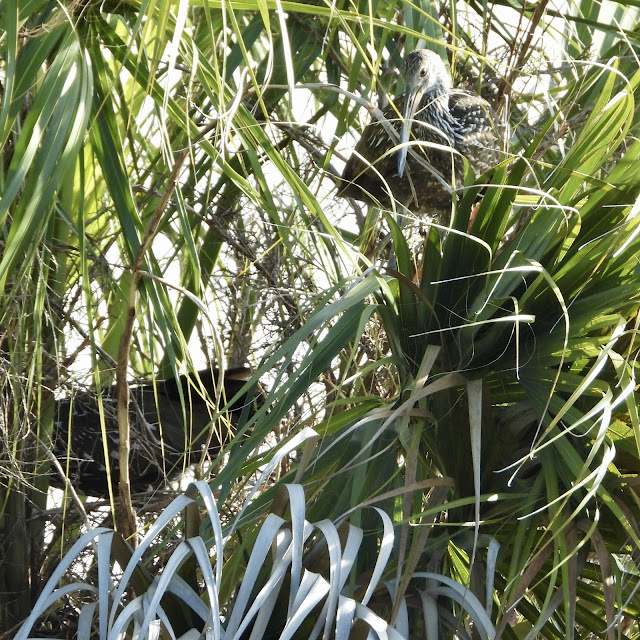
Limpkins chasing each other, then building their nest in an untrimmed Sabal Palm. 


American Fish Crow


No photo, but walking home from the pool two nights ago, we saw and heard two Barred Owls caterwauling. Now, if they'd just choose that nesting box in Pineneedle to make a family.

Early December 2021, sightings


Orchid Bee, in a Pineneedle butterfly garden.

This post is a collection of recent sightings in Wildewood. 

As I headed out for a walk this morning, Pat told me about the Barred Owl swooping over her to land on Nadia's courtyard wall. This week. A little later on the walk, Michael said he woke his wife to listen with him to two Barred Owls caterwauling in Springlakes. 

Daily I see warblers in the Laurel Oak canopy behind our place.

An early morning sunrise on a Red-Bellied Woodpecker. A male.


And a female.

In the same tree.


A Wood Stork and an American Fish Crow sharing a Norway Pine treetop. I knew it was a Fish Crow by its call.


A Red-Shouldered Hawk calling and calling. Tom was walking home from laps at the pool and heard it. I checked, and here hawk is:

Calling to who? I found them both here. Looks like it's find a mate season.

On Thanksgiving day, Marc Holtsberg sent this photo - an American Bald Eagle, taken in our neighborhood.

And, a few days ago, he photographed a juvenile American Bald Eagle in the Springlakes area off of Wildewood Drive. 


An Orchid Bee - a living jewel! 


On the big pond, a lot of Wood Storks following the rules. Looks like that Great Blue Heron has a mind of its own as it heads to the pond.


This is how some of our shell-back neighbors greet each other. Peninsula Cooters.


Birds are habitual. So, if you see a hummingbird at a particular place at a particular time of day, try again the next day. Chances are you'll get another sighting. This Osprey is on a Slash Pine branch many mornings I walk - I watch it leave to then grab a fish from the pond behind Tidewater.


Tricolored Heron, last of the molt. 


Spring! Yellow-crowned night herons, yellow-bellied sapsucker, limpkin, and crow


A friend reported that a pair of Yellow-Crowned night herons is building a nest over the pool in the Woodlawn area in the same place pairs have nested for years. I grabbed my camera and headed over to look up. Woodlawn neighbor Eddie showed me two other nests in nearby slash pine trees. That makes 3 pairs nesting!


On my walk home, I spotted a Yellow-bellied Sapsucker, a migratory bird protected by state and federal wildlife law. I've been watching for this bird in this place because the palm has the bird's characteristic horizontal holes from feeding. Those holes usually cause no harm


While walking up to my front door, I looked up and saw a Fish Crow with nesting material. After reading Jennifer Ackerman's book, Genius of Birds, I know this is one of the smartest of all birds (probably recognizes my face). (What's a Fish Crow? Look here. How did I know? The Fish Crow's call is distinct from the American Crow's caw. Listen here to hear what I mean.)


There's more.

Limpkin lit on the tree out our back window and called loudly. How loud? Like this. It was my first sighting of this crane-like bird in Wildewood, though neighbors report seeing them. A thrilling birding day.


I noted Earth Day by the trees I kept from growing

Carrotwood Tree seed pod. Susan Michael Barrett.

“What are you doing, Susan?” a neighbor asks.

“Picking up Carrotwood seeds.”

“Why?”

“To take care of the babies.”

“Babies?”

“Oh. I mean the mangroves. Mangroves are the ocean’s nurseries.”

“I don’t get it.”

“You see, birds, especially that American Fish Crow, binge on these like I eat potato chips. And then they poop them everywhere.” (I point out a vociferous antiphonal caw duet between a pair perched nearby.)

“Say more.”

“Mangrove Trees aren’t highly competitive. The aggressive Carrotwood Trees are. They’re altering the natural biodiversity. So these potential trees deeply affect our oceans.”

“I didn’t know that.”

Pause.

“I’ll help you pick them up.”


NOTES
The Carrotwood Tree was introduced into Florida about the year I was born. It is described as desirable, fast-growing, easy to propagate, disease and pest-resistant, and adaptable to coastal conditions. 

The Carrotwood Tree gets an A+ in adaptation.

Here’s the F part: it’s aggressive. Like on the top tier of invasive trees to Florida aggressive. A plant or tree can become aggressive when it leaves its native place where it has predators and controls—where it’s part of an ecosystem that works.

The Carrotwoods in Wildewood Springs IIA were planted in the late 70s before landscapers knew what they now know. Now it is illegal to plant a Carrotwood tree in central Florida. Until they’re removed, we prune them before they seed. 

Tons of branches bursting with seedpods were cut this week. Afterward, I filled two super-size trash bins with nickel-sized seeds that fell on the ground during pruning.