Showing posts with label European Honey Bee. Show all posts

Last stroll through WWS of 2023


Barred Owl, December 29, 2023

A new year begins. May it be rich and meaningful!

As you might know about personal loss, the two months since Terry died have been full of grief with a particular loneliness and longing to talk to him about this remarkable dying experience. John O'Donohue knew of this when he said, "Lonesome for all the conversations we never had," and more. Conversations spontaneously arise in my mind as I wonder what Terry would think. 

When a wave of grief arose, I'd step outside and start walking. To be with the birds and trees. With nature. 

Poet Rainer Marie Rilke's recommendation for when things get turbulent and troublesome: stay close to nature. I have. So here are some things I noticed and photographed. 

I'll begin with the lucky sighting of a Barred Owl two days ago, around 4 PM, across the pond from the butterfly garden in Pineneedle near my place. I've heard it multiple times very early (3 - 5 AM), and then yesterday, I heard caterwauling, so it looks like a pair might nest nearby.

Cormorants on the big pond. Many of them! 

Wood Storks resting. Edge of big pond.


A female Eastern Grey Squirrel. Notice her teats - nesting in a Laurel Oak.


Mourning Dove taking a bath in a puddle.

A pair of Limpkins, north Wildewood. A Limpkin hanging out with juvenile Wood Storks, big pond.


Anhinga catches a fish.


Red-bellied Woodpecker. See the red belly?


Tri-colored Heron, north Wildewood pond near Pickle Ball courts.


Bluejay and Northern Cardinal


So many ducks in the ponds. This is an American Widgeon.


Monarchs finding nectar in Orchid tree blooms. Woodland Village.


European Honey Bee hive, north Wildewood Drive in a wooded area.


The Dombeya tree is blooming, and the bees are delighted!


A bird of a different sort - took a helicopter ride with a granddaughter. What fun! Saw the gulf from a bird's-eye view.


See what you can see - January 2023


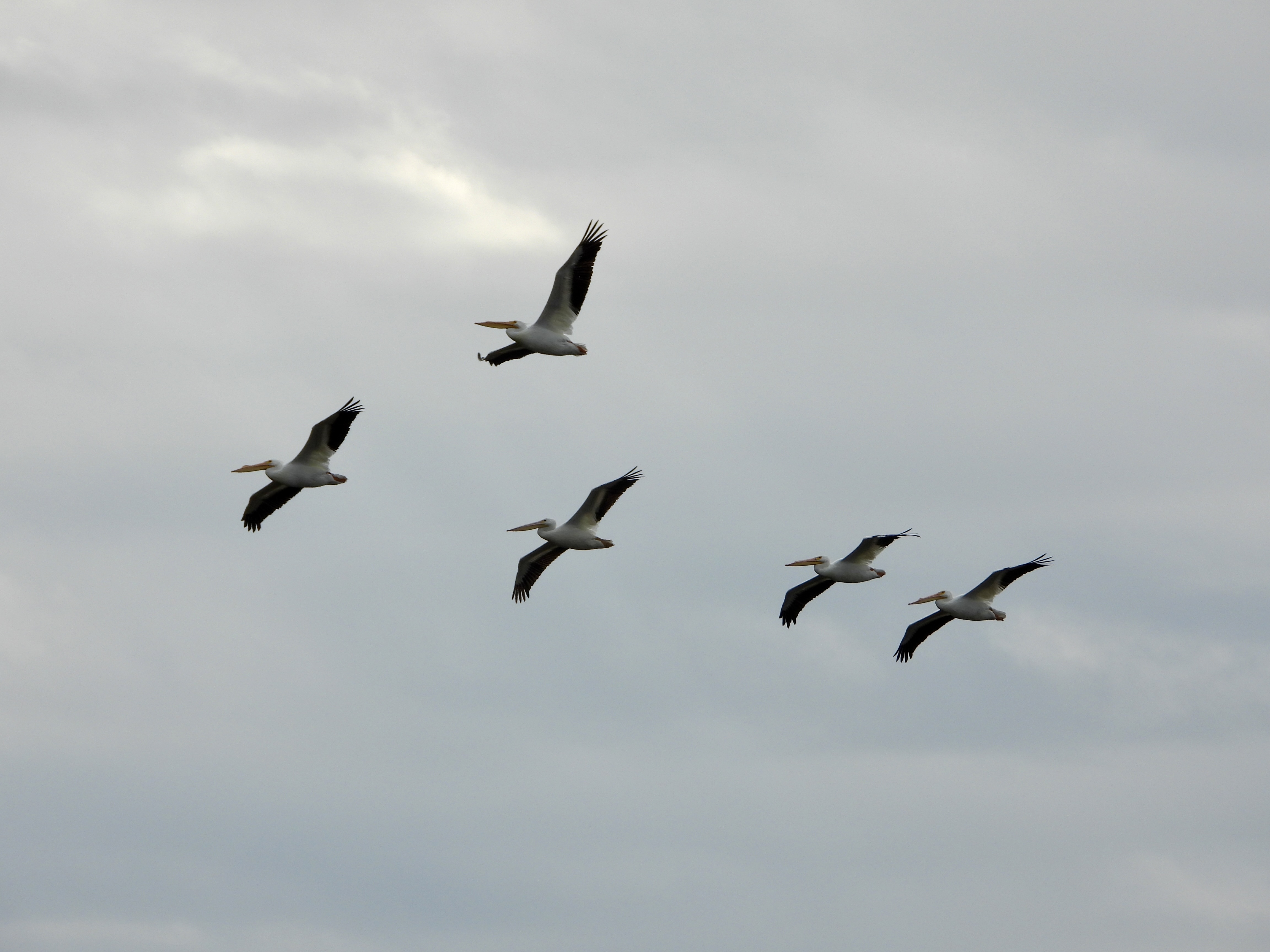
White Pelicans, January 28,2023

This week I revisited Jon Young's, What the Robin Knows, a book that deepens the kinship between humans and species. In it, he offers a simple suggestion to foster that kinship: go outside for twenty minutes to see what you can see. 

I did that. Here's what I saw after immediately stepping outside. A Yellow-rumped Warbler and then a Blue Jay.


Then I headed to the big pond. Ringed-necked Ducks, male and female


This photo of the Blue-gray Gnatcatcher shows the color of its name. Contrast this photo with this one taken at sunset. This photo deceives - this bird is super tiny.


A Common Snapping Turtle crossing Oak Drive. There are two types of snapping turtles in Florida. The Alligator Snapping Turtle has more ridges on its shell.


Two Northern Mockingbirds doing a spring dance - either territorial or mating.


And here's what neighbors saw recently. 


Kat tends a butterfly garden behind her unit, one with many Monarch caterpillars. She noticed a Monarch Butterfly just before it emerged.


Betsy saw a Monarch butterfly on the Mexican Marigold bloom in the butterfly garden.


Marc Holtsberg came upon a thriving hive of European Honey Bees. Beekeepers tell us this is a sign of a healthy ecosystem. 


Maybe those bees were the ones who found nectar from the Dombeya in front of our place.


Marc also took this beautiful photo of a juvenile Bald Eagle (at Robinson Preserve).


He also was delighted by the Great Horned Owl fledgling. Its nest is adjacent to the entrance to the north entry of Robinson Preserve.


Nadia noticed the sunset. Look at that color.


Nesting box transformation


Good news and unexpected news. Which first?
April 21, 2022

Good? We have a healthy population of honey bees in our neighborhood. 

Unexpected? The honey bees like the owl nesting boxes and once bees inhabit a box, it's theirs.

Neighbor Barb Reis documented the removal of the bees and nesting box.  


To fill in the gaps:

European Bees found the Barred Owl box. Since it was close to units, the HOA decided it was best to remove it.

When bees claim a nesting box, they also leave pheromones, a complex communicating system that birds sense. Birds will not return to that nest unless it is sanded and treated with special paint. 

There was a good chance if we did the sanding and painting that the bees would use it again!

Bees were not killed. (Bravo to our HOA.)

There were two removal sessions. The Queen was removed in the first suction along with other bees and taken to another hive. Kathy Vollmer took this video.

The rest of the workers and honeycomb were removed when the box was taken down. The bees in the second removal were also taken to hives.

Another nesting owl box is still hanging on a tree across the pond behind Pineneedle. It has enough distance from units that the splitting of a swarm would not alarm neighbors.

We still have a Barred Owl pair in the neighborhood. It looks like they are okay with having a brood in the wild. I hear them most early mornings (3 -4 AM) and see their broad wing span quietly glide across the pond to Woodlawn.

If you donated to the Owl Nesting Box project, we hope you see the value of providing nature this support even when the inhabiters are not the expected guests. Thank you again.