Showing posts with label Blue-Grey Gnatcatcher. Show all posts

See what you can see - January 2023


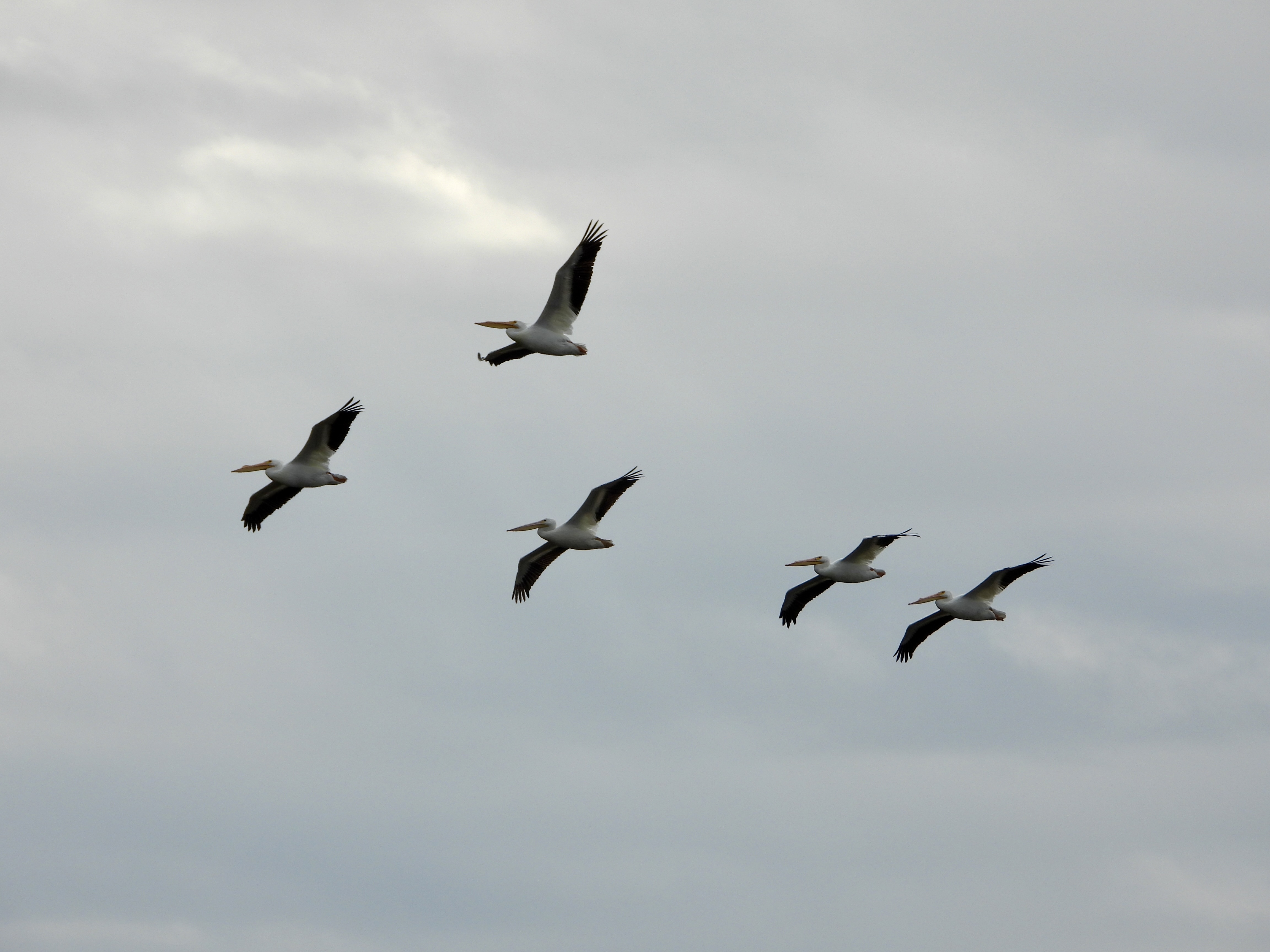
White Pelicans, January 28,2023

This week I revisited Jon Young's, What the Robin Knows, a book that deepens the kinship between humans and species. In it, he offers a simple suggestion to foster that kinship: go outside for twenty minutes to see what you can see. 

I did that. Here's what I saw after immediately stepping outside. A Yellow-rumped Warbler and then a Blue Jay.


Then I headed to the big pond. Ringed-necked Ducks, male and female


This photo of the Blue-gray Gnatcatcher shows the color of its name. Contrast this photo with this one taken at sunset. This photo deceives - this bird is super tiny.


A Common Snapping Turtle crossing Oak Drive. There are two types of snapping turtles in Florida. The Alligator Snapping Turtle has more ridges on its shell.


Two Northern Mockingbirds doing a spring dance - either territorial or mating.


And here's what neighbors saw recently. 


Kat tends a butterfly garden behind her unit, one with many Monarch caterpillars. She noticed a Monarch Butterfly just before it emerged.


Betsy saw a Monarch butterfly on the Mexican Marigold bloom in the butterfly garden.


Marc Holtsberg came upon a thriving hive of European Honey Bees. Beekeepers tell us this is a sign of a healthy ecosystem. 


Maybe those bees were the ones who found nectar from the Dombeya in front of our place.


Marc also took this beautiful photo of a juvenile Bald Eagle (at Robinson Preserve).


He also was delighted by the Great Horned Owl fledgling. Its nest is adjacent to the entrance to the north entry of Robinson Preserve.


Nadia noticed the sunset. Look at that color.


Birding fosters community

Wood Ducks, male and female and a Mottled x Mallard duck. March 6, 2021

Birding fosters a sense of community. It is delightful to hear from you about what you're noticing in Wildewood Springs. 

Steve from Woodlawn emailed. "Saw the Wood Ducks bobbing head courtship behaviors. Time to watch them." Yesterday I watched for over an hour and noticed that 2 hens are tending the nesting box! This photo is early morning; perhaps this is the nesting wood duck family.

Late morning, I can almost hear this hen say, "Your turn." Notice the change in light quality?

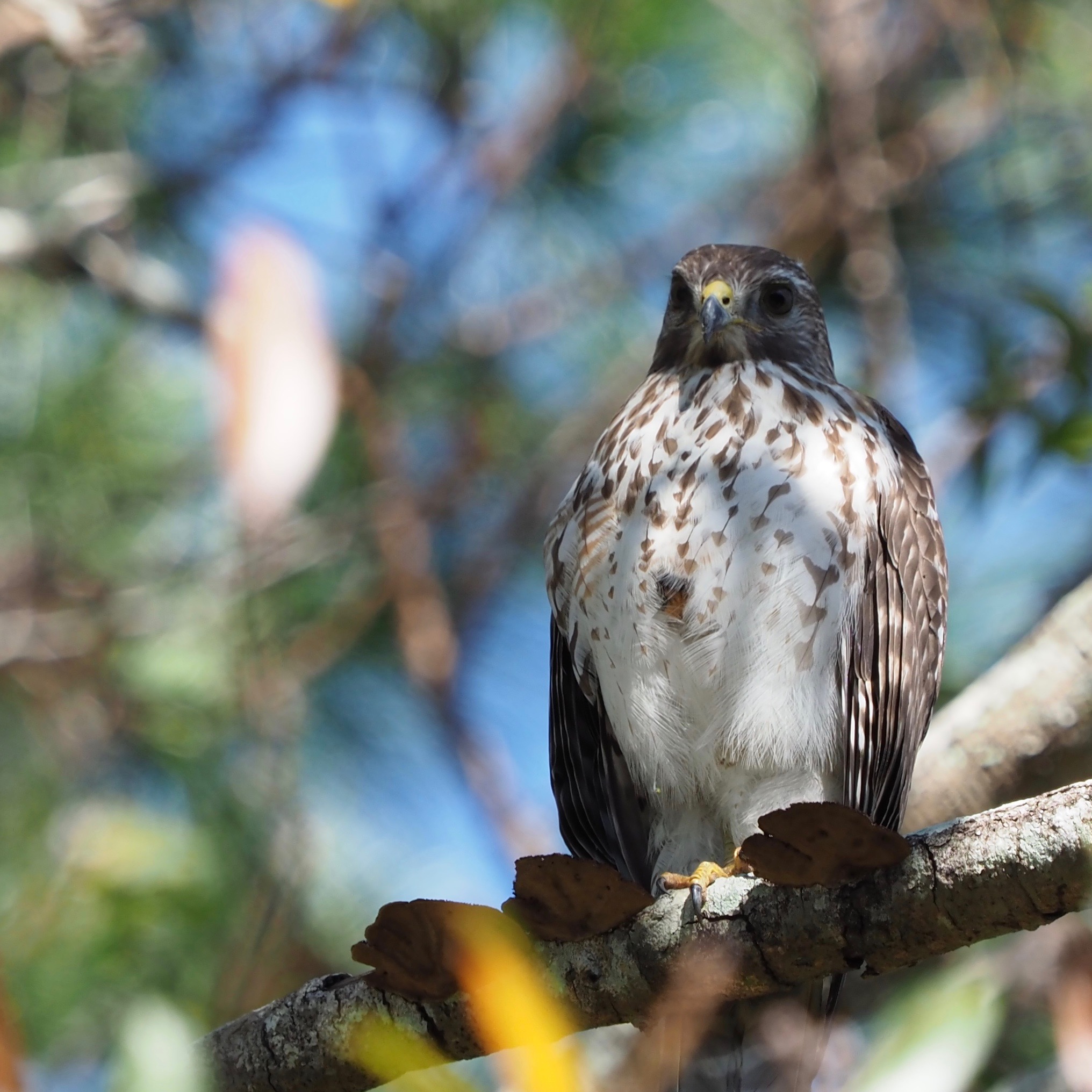
Maureen reported Red-shouldered Hawks mating at the corner of Wildewood and Oak Drives. If these red-shoulders have chicks, they'll look like this.

Maureen is a Lakeside neighbor who regularly picks up trash in and around our neighborhood. Maureen, do I say thank you enough? Thank you.

Faith saw an Osprey carrying large nesting material to their nest in the neighborhood and later, a pair perched together atop a tree on Wildewood Drive. She also saw one fly while carrying snake (a delicious meal if you're a raptor). So here is a photograph of a Wildewood residing Osprey taken by neighbor, Marc Holtsberg. Maybe its chick from last season is one Faith saw returning to its nest to have a family.

(Faith also saw 3 otters playing in the big pond. I photographed one in the Pineneedle pond this morning.)

Walter saw a Green Heron. I saw one of the pair flying back and forth nearby and then perch. I photographed it with Walter's camera. He loaned it to me when mine was recharging. Thanks, Walter.

Lois paints from her second story porch. While painting she said she had a visit from a small bird nibbling small insects from the window. Maybe it was a Blue-grey Gnat Catcher.


Or a warbler? Was it this one, Lois? A Palm Warbler? I took this photograph near the carport where your car is. Or look at this post for other warbler types. What luck to see these sweet, small birds up close.

Betsy mentioned that her sister who is visiting Wildewood thought that she saw an Oystercatcher since it had orange on its beak. This is possible, though I've not had a sighting in Wildewood. Head to the beach and you'll see them. 

Using that orange on the beak for a clue, I've seen the Black Skimmer skimming the big pond. Mostly I see them at the beach in large groups. Here is one of 3 skimming the water and some other photographs I took of their courting behavior.

Or, perhaps Betsy's sister saw a Common Moorhen or Common Gallinule. There are regular sightings of this bird here, especially on the edge of the big pond. 

Or maybe, it was a Muscovy Duck. Here's one I photographed near Timberlake. The fun part is that with our clues, we can check bird books and websites for help with identification.

Some exciting news! 

This week Jeanne and Tom Higbee and Toni had their first sighting of a Yellow Crowned Night Heron in the Slash Pine that held multiple nests for over five years. Though they are year-round residents in Florida, this is the time of year that they nest. Betty Pander wrote to say she saw the Herons on the bleached branches across from the Pineneedle and Woodlawn pond. Their sightings inspired me to go outside and look. There were 3 on the bleached branches.

Then they flew off in the direction of the Slash Pine they favor.


At 4 AM, I saw one of my favorite wildlife neighbors, an opossum, from our back window. I've been a fan ever since I had a chance to hold one when a wildlife group visited my classroom years ago. I wrote about how the opossum is a good friend to our habitat


Last, a common query: have you heard those two geese (Canada Goose) fly over like they're our early morning alarm clock? I have. These two.


Here is one settling in for a nap after waking us up. 

Beautiful bird, I see you: a humbling act of reciprocity

Pat said, "I saw our friend." 

She was referring to a resident Red-Shouldered Hawk often perched in what appears to be a favorite area at the bend of Pineneedle Drive. (I took this photograph earlier this week, January, 2021).

A sighting is a humbling act of reciprocity: we give care and protection to wildlife partly in return for the gifts they give us. There are many gifts bestowed by birds and wildlife to the cycle of life, but here it's delight. Then we extend that story by sharing our experiences with other people through story-telling (the earliest of social "media").

I thought about what it means to see a Red-Shouldered Chick or Blue-Grey Gnatcatcher or Great-Crested Flycatcher or Blue Jay or Blue-winged Teal Duck.  

Or any wildlife.  

And now Pat's telling is shared on this website. 

PS. From a subscription website called Birds of the World: more about the Red-Shoulder Hawk

Monarchs thrive with Emily's care


I passed neighbor Springlakes neighbor Faith on a walk recently. She says, "Susan, there is a woman who raises monarchs a few streets over. She's lived in this area for over 50 years. You have to find her."

So I begin walking up and down every street looking for a cloud of monarchs or some indication of a butterfly garden. At the end of one street, I see a yard alive with wildlife! Quick, I snap this photo of a Blue-grey Gnatcatcher.


I notice Northern Cardinals seemingly playing hide and seek.


And, an Eastern Phoebe.


I knew I found her!

As I stood trying to identify the many birds in her front yard, someone came out to check the mail. I meet Emily's husband. As I type her name, my brow furrows and I wonder if maybe her name is Emma. "I'll tell her to come outside." 

Emily Eagle. That is her name! (I begin dreaming of a new name for myself. Susan Songbird?)

Emily is beautiful. Her face glows. I thought that this is what it looks like to live a life of wonderment. She invites me to see her backyard and begins introducing me to her plants as if they are children. That kind of appreciation and reverence. 

She points to two tall Norfolk pine and a screened gazebo where she and her husband spend early mornings sitting and watching regular visits from a pair of American Eagles. (Now I know where Wildewood's eagles might spend time.) This tree— I hear then see American Crows.


In the backyard, there are many tables of planters filled with pots of baby milkweed grown from seed. And pots of milkweed growing in gardens.


Emily points out the monarch eggs on the backs of the leaves.


She then points out the small caterpillars. "As soon as I see the caterpillars, I place the whole plant in the hatching box." She carries this plant to the box.


"My husband built this to protect the caterpillars from wasps and other predators." Emily places the newly found caterpillars and notices a chrysalis on the screen that has changed from emerald green to a dark color. 

"It is about to hatch." When it does, she opens the box and the monarch flies away.


 "Oh look! Here is a chrysalis. Take this, Susan."


Another fascination was listening to Emily tell stories. 

Decades ago, Paul Neal, developer of our area, would sit outside with Emily and her husband. They'd eat and them give him oranges from their trees. In that friendship, Neal offered them land for sale that separates Wildewood from their area. Adjacent to the Eagle's is a pond and mature trees. The Eagles eventually divided the land they bought from Neal into two large, though smaller plots. "We have the best neighbors." 

Emily says that Wildewood was a wetland where cattle roamed. The largest Wildewood "lake" - about 30 feet deep was dug when Neal added land to some of the low lying areas. 

As I left with the milkweed plant and chrysalis, Emily says, 

"Do you have a screen box?" I don't. She then asks, "How about a screened porch?" Yes! 

I tell her about our area's butterfly gardens and how I see the wasps hunting for food. I now know how to foster the process. Our porch might become a butterfly nursery. I leave with confidence about how to help monarchs get to the butterfly stage. Thank you, Emily.

Blue-Grey Gnatcatcher


Blue-Grey Gnatcatcher, November 2018, reflects color of the setting sun. 

A neighbor asked, "What are those little birds up in the trees? I see movement, but they are too fast to see." I need a photo to know for sure. Could be warblers or other songbirds. Here's one it could be. A Blue-Grey Gnatcatcher. Notice the white ring around the eye and its straight bill. If you cannot see the Gnatcatcher, still and listen to its song or call. It sounds like THIS.

You can probably guess its diet. Gnats!
[Gnat-catchers] feed on a wide variety of small insects, including leafhoppers, treehoppers, plant bugs, leaf beetles, caterpillars, flies, small wasps, and many others. Also eats many spiders. - Audubon
Knowing that so many songbirds depend on insects makes me glad that our community is careful with herbicides and pesticides. 

Are you wondering about the "grey" part in the name? After all, that bird above appears orangish.This is a light lesson - the setting sun bathes the bird in a transforming way. 

The next day in the Laurel Oak tree behind our place, I took this photo. Its blue-grey coloring is prominent.