Showing posts with label Northern Shoveler Duck. Show all posts

Big pond duck meet up


Female Northern Shoveler Duck snuggled into a ball shape, and male Shoveler. 

About 8:30 this morning (2/4/22) I noticed a lot of ducks meeting in the middle of the pond - mallards, ring-necks, scaups, shovelers, widgeons, and mixed breeds.


Before I arrived at the pond's edge, I noticed a commotion of small birds in the Southern Oak trees. I heard then saw Grey Gnat Catchers. I got a photograph of one.


Polioptilids (a Gnatcatcher's formal name) glean small insects and other arthropods from leaves and branches, often flicking their tails actively as they forage. Despite their name, they very rarely take flying gnats on the wing.

A Tufted Titmouse singing like it was the best day ever. I agreed.


A female Downy Woodpecker. The tapping sounded like drumming. Both sexes drum on trees to claim territories, attract mates, and signal readiness for mating. The drumming is made up of very rapid, steady strikes almost fast enough to blend into a single sound.  All About Birds


A male Red-Bellied Woodpecker on an adjacent tree showing evidence for the red-belly name. "Hey, I hear you, Downy Woodpecker, nice drumming.


Then there were several Palm Warblers. Here's one.


And then, oh my duck galore.
American Wigeon pairs were happily eating and making sounds like this. Wigeons are one of the more vocal ducks - their 3 part nasal whistle sounds a bit like someone softly blowing through a kazoo. Once you listen, you'll be able to identify this duck without seeing its markings.
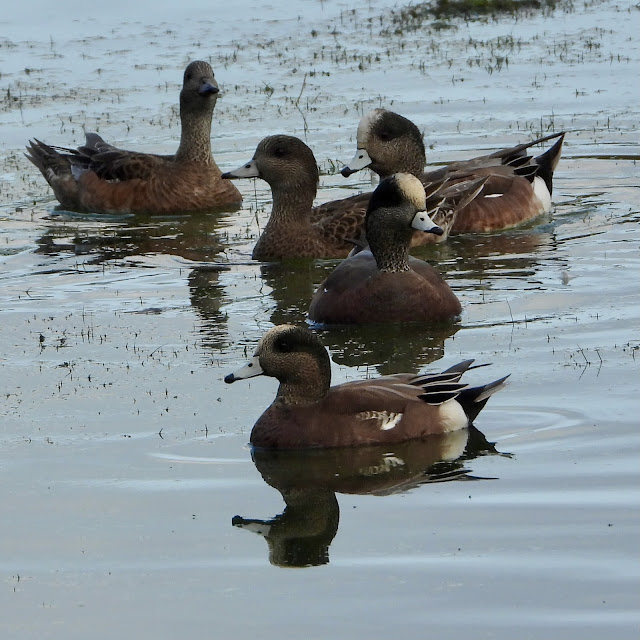

A male American Widgeon has  a wide green postocular stripe seen when the light shines on it just right. Like this.

Two male Ring-Necked Ducks. So that ring neck identification? It's a cinnamon ring at the base of the neck, which gives the duck its name. It's a very poor field guide seen only at close range in good light. To date, I haven't seen it.


Northern Shoveler. Female and male. That beak is shovel-shaped all right.


Female


Male shoveler.


And last, a pair I've photographed over the last couple years. A mallard hybrid and a female so mixed in breed that a duck like this is referred to as "weird." (All About Birds says more about confused domestic ducks and hybrids here

Well, I got a look at how confused-hybrid happens. These two were swimming along.)


A male Muscovy Duck appeared. The pictures show what happened.


And just like that, a pair became a trio.

February 2021, on my walk I saw...


A Tern? (certain) Royal Tern? (maybe) - Looking for a fish? (certain) 

When I look at birds while wearing my camera, most people I pass ask, "What did you see?" This is a response to that question.

The first photo is of a tern. But, which one. I thought Sandwich Tern. A couple birders (What's this Bird?) think this is a Royal Tern rather than a Caspian or Sandwich Tern. Rebekkah Leigh LaBlue who studied Least Terns in college wrote:
Personally, I would say no to Sandwich.

I’ll also say the angle and backlit nature of the photo DOES make it hard to concretely discern the color of some features, but the bill here—to me!—looks orangish. Even if it were an immature bird (which have more orangey beaks), this far into the first winter the beak would have gone black (with the characteristic yellow tip, like it was dipped in mustard—hence the Sandwich Tern name ðŸ™‚ ). Making less assumptions about the color, the bill looks too large, pointy, and thick at the base for a Sandwich Tern.
This tern is overall larger-looking to me. I also think the wing tips look too dark for a Sandwich Tern (but whether this is just backlighting is hard to say).
With that really pointy and chunky-based beak, darker wing tips, and what looks like a black cap, I’d suggest this is more likely a Royal or Caspian Tern. The cap on a Caspian extends below the eye; it does not on a Royal; I can’t tell here which is true.
All said, I think it’s hard to positively name a species here. But I DO think—personally!—you can rule out Sandwich. I can't confidently ID more specifically than that. (But my gut says Royal, for what it’s worth.) Would love someone else to throw in their two cents, also, since I've likely made a lot of assumptions, here!

I saw a male Northern Shoveler.

It's bill is BIG (about 2.5 inches) and shaped like a shovel. "The bill has about 110 fine projections (called lamellae) along the edges that act like a colander filtering out tiny crustaceans, seeds, and aquatic invertebrates from the water (All About Birds)." 

Two photographs, both Yellow-rumped Warblers. I still need help identifying warblers! They are so fast and we have many varieties during Florida's winter.


I saw a Great Blue Heron.


I saw an Anhinga.

Anhinga dries its wings looking out over the big pond. "Supple in water, clumsy on land, the anhinga is most serenely at home in the air. When not otherwise engaged, it spirals upward to breathtaking heights. There, with others of its kind, it rides the wind for hours on end for no apparent reason other than the simple joy of soaring."  - Book of North American Birds, p. 341.


I saw two White Pelicans flying over. 
Or, from another view, is that the sky looking back at me?


I saw a Red-bellied Woodpecker in its nest or where it sleeps.