Showing posts with label Great Crested Flycatcher. Show all posts

A little luck - a Cardinal nest

Northern Cardinal, April 2022

Sometimes I feel super lucky. A Northern Cardinal pair chose the Dombeya in our inner courtyard to build a nest. What's a Dombeya (Florida Hydrangea)? You'll remember with this photo when it was in bloom. 

After blooming, the tree needs to be pruned back. So it looks like this now. Perfect for a nest, right?


Under the garden, a biodiverse selection of plants alive with color and insects, and water bath. 


So, just moments ago from the kitchen front window. I saw the male sitting in the Bottlebrush with a mouth full of seeds to bring to her. The process is like this. Sitting and sitting on that nest calling and calling as if saying "I'm hungry, I'm hungry." Oh my, she is devoted. And he, so serious about his responsibilities.


To create less disturbance, I often leave from the back door and walk through the butterfly garden. Looking out back has some luck in it, too. I saw this Great Egret in breeding plumage, pruning and posing as if knowing I'd show you.


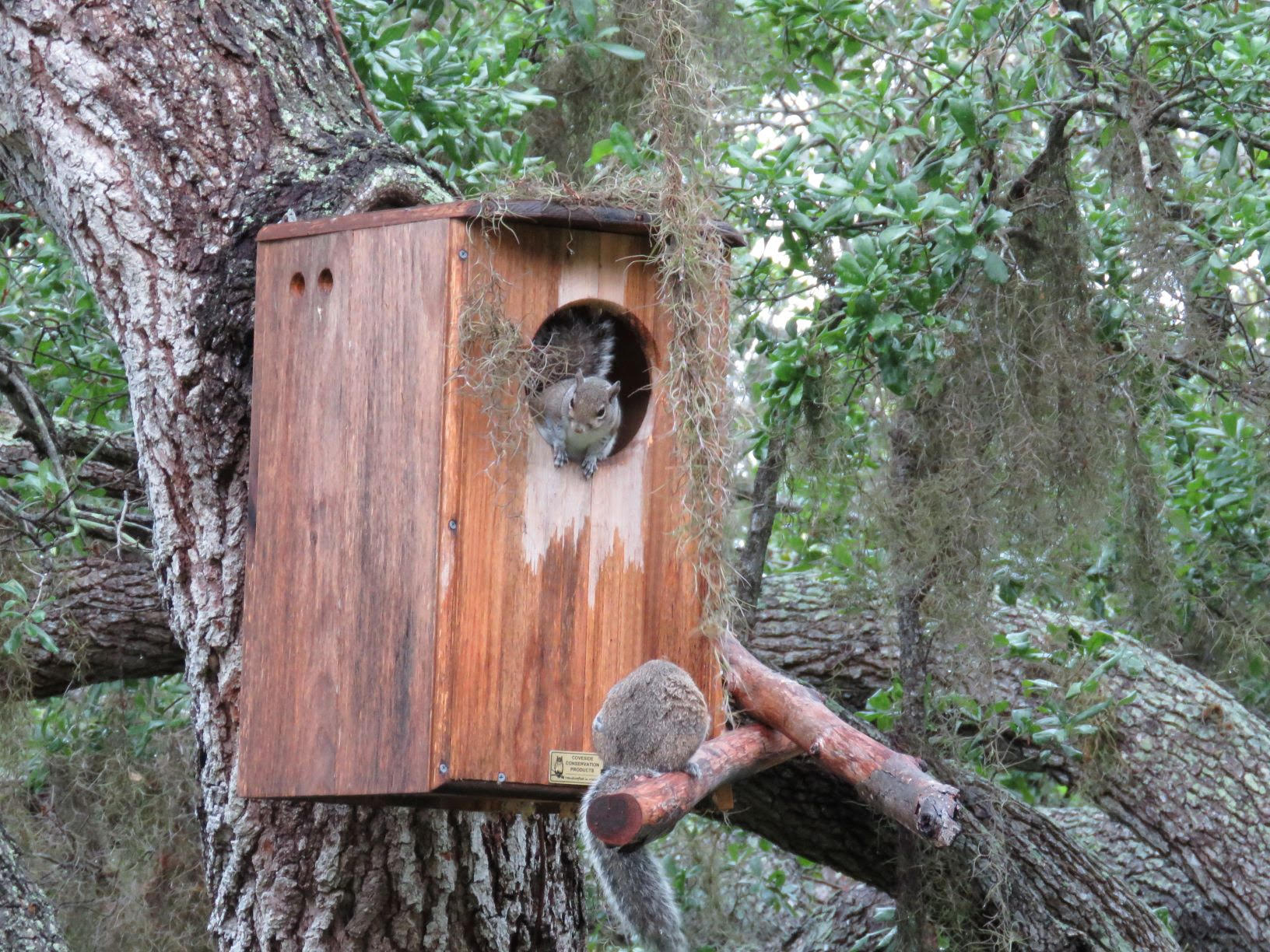
And a Great Crested Flycatcher on the Wood Duck box.

What a full wildlife morning!


Northern Cardinal fledgling, May 22, 2021

Yesterday my new camera arrived, so I headed out hoping I'd have something to share today. I do!

I heard frantic Northern Cardinal chirping and noticed a grey cat leave the front area of a unit. The adult pair continued their alarm call while flitting from the ground to the roof line, as if intentionally distracting the cat. Papa cardinal was fearless.


The cat ran off. Then I found the nest and a fledgling. (May 22, 2021) 

The adults together flew from the fence to the fledgling and then to the nest. Baby bird found its way back.


See the tip of the tail of the male guiding the fledgling?


Next I saw a Great Crested Flycatcher.

A European Starling fledgling. There were two, here's one:

A Northern Mocking Bird fledgling.

A Wood Duck pair seemed to snuggle while their chicks played and bathed in a safe corner of the pond.


Two of the six ducklings, backlit by the rising eastern sun.

A male Red-bellied Woodpecker.

Every day I scan the Barred Owl's territory. This bird camouflages so I slowly moved my gaze along the Southern Live Oak branches. I was about to give up and then came its call that sounds like "who cooks for you?" 


Sometimes, it's easy to spot the Barred Owl. Like this photo from Pat Larkin taken a few days ago (on May 9, 2021). Why hello.


In case you were wondering if a Barred Owl would prey on any WWS dogs - the largest Barred Owl known weighed 2 pounds, 2 ounces. A Barred Owl will not catch and eat anything that exceeds its weight. 
Diet: 55.0% mammals, 23.1% invertebrates, 16.1% birds, 3.3% amphibians, 2.5% fish...Considered a seminocturnal to nocturnal hunter, although diurnal hunting observed. Hunts in a sit-and-wait fashion from an elevated perch scanning area for prey. Acute vision and hearing apparently used to locate prey. Takats (91) observed a female drop from a perch to capture a vole on the forest floor, as well as make several passes in attempt to capture a red squirrel (Tamiasciuris hudsonicus) in a tree during the day. Known to perch over water and drop to capture fish (92). Observed wading in shallow water to capture fish and crayfish (M. Gibson pers. comm.). Reported to hunt from the ground, running and pouncing on prey such as amphibians (936, KMM)...Hunting activity highest immediately following sunset (6). Birds of the World  

Recent visitors to the owl nesting box

Look! A Tufted Titmouse in the owl box.

Barb Reis has her eye (and camera lens) on the owl nesting box. All photographs on this post are hers .

The titmouse gathers wood chips from the floor of the nesting box. For a nest perhaps?


A Red-bellied Woodpecker, female. 


A pair of squirrels take cover after a rain.


A Great Crested Flycatcher in the owl box - is bird daydreaming?


And then...oh my goodness. We have been waiting for a Barred Owl to find the box!


Beautiful bird, I see you: a humbling act of reciprocity

Pat said, "I saw our friend." 

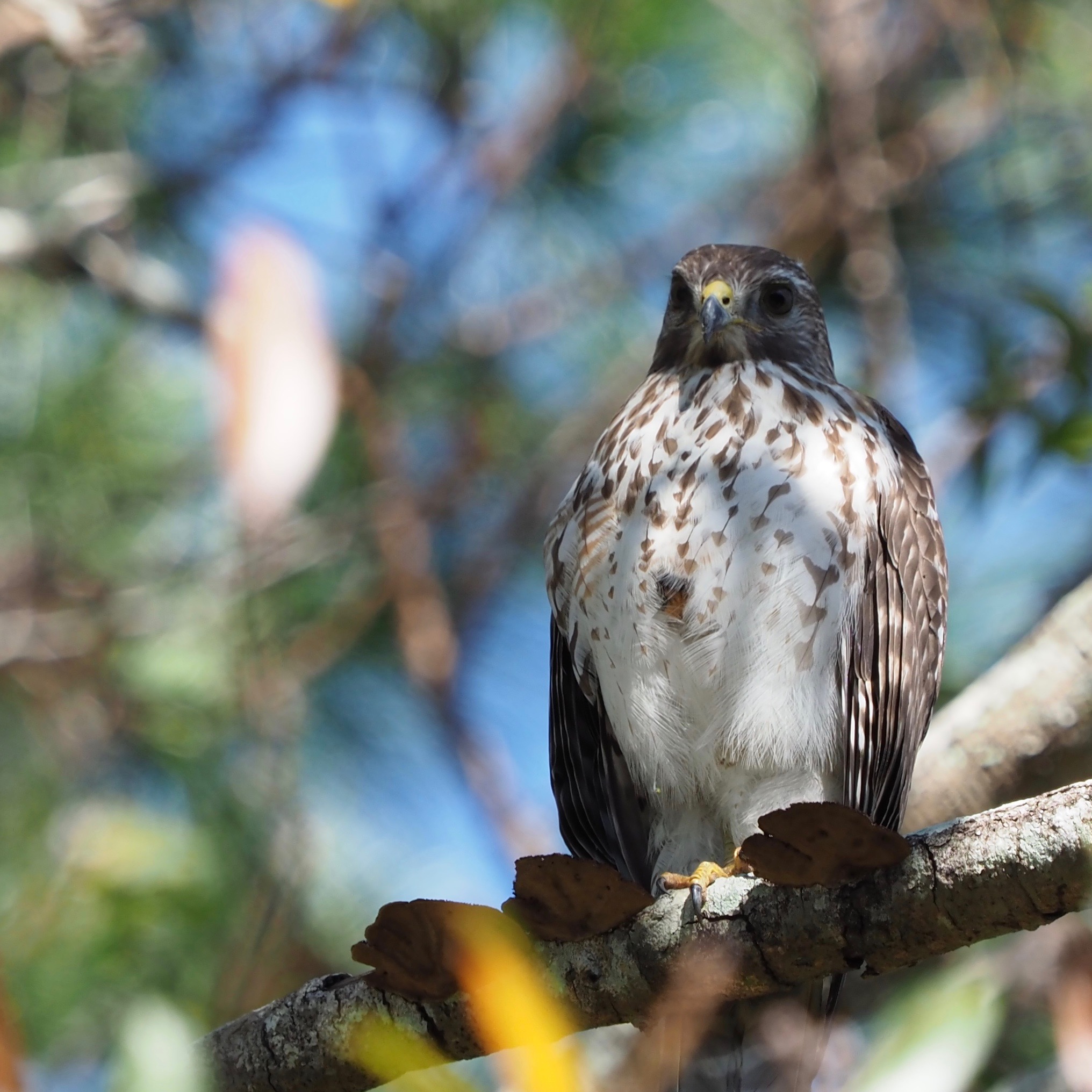
She was referring to a resident Red-Shouldered Hawk often perched in what appears to be a favorite area at the bend of Pineneedle Drive. (I took this photograph earlier this week, January, 2021).

A sighting is a humbling act of reciprocity: we give care and protection to wildlife partly in return for the gifts they give us. There are many gifts bestowed by birds and wildlife to the cycle of life, but here it's delight. Then we extend that story by sharing our experiences with other people through story-telling (the earliest of social "media").

I thought about what it means to see a Red-Shouldered Chick or Blue-Grey Gnatcatcher or Great-Crested Flycatcher or Blue Jay or Blue-winged Teal Duck.  

Or any wildlife.  

And now Pat's telling is shared on this website. 

PS. From a subscription website called Birds of the World: more about the Red-Shoulder Hawk

More wildlife around? Or more stepping out to look?


Nature is busy. Each day brings their hellos.

Early mornings have been starting with Red-bellied Woodpecker drumming. Gutter then on Sabal Palm leaves. The sound difference invites me to notice little things. 

Let me remember to look out and up like the woodpecker. 

This is your sweet alarm clock, wet from the morning dew. 


A Peninsula Cooter turtle (identified by a Turtle group I belong to) heard his call. How did I know this is a male woodpecker? Look HERE.


My camera lens chases Red-Bellied across the pond to a Live Oak tree.


A few photos and then, another bird call from that tree! A Great Crested Flycatcher. A pair. Singing to each other (and to us).


Mid-morning Betty and Selma sent an alert. Otters! Today, eight of them several times during the day. Such tussling about.


Here are four of six in what appears to be one family. (At the same time, downstream, another two swim through the grate to cross under Oak Street to the big pond.)


An adult otter watches them. A penny for your thoughts parent of these?


My thought is that the parents can't corral the little ones into the den. Maybe. 

A little later, Mike, a neighbor across the pond calls to me and points to the top of a tree in the butterfly garden. "An American Bald Eagle perched there just a little while ago," he said. 
"Can you believe all the wildlife around right now?" a friend asks. I pause and wonder if the more is really about how often we are stepping outside to look out and up. A positive to this unlike-ever-before time in our lives.

I feel so fortunate to live here. 

Great Crested Flycatcher catches a Lacewing


On a walk this week, I heard a Great Crested Flycatcher and stood still for more than five minutes hoping to see it. (The call is distinct.)They're hard to see because they perch and move deep within the tree canopy.

Then a pair flew to an Orchid Tree close to where I stood. What a treat! One hunted and caught a lacewing—a designated beneficial insect beyond nourishment for flycatchers and other birds.


The two are active! I didn't get a photo of both together.

From All About Birds:

Cool Facts
  • Great Crested Flycatchers weave shed snakeskin into their nest. Where it's readily available, as in Florida, nearly every nest contains snakeskin. They also seem to look for flimsy, crinkly nest materials—they’ve also used onion skins, cellophane, or plastic wrappers.
  • Though they’re flycatchers, these birds also eat a fair amount of fruit. Instead of picking at the flesh of small fruit, Great Crested Flycatchers swallow the fruit whole and regurgitate the pits, sometimes several at a time.
  • Where other insect-snatching birds like Eastern Wood-Pewees, Least Flycatchers, Acadian Flycatchers, or Eastern Phoebes share their habitat, Great Crested Flycatchers exploit a niche higher in canopy to avoid direct competition for food. High up, they swoop out farther for prey, using multiple dead-branch perches.
  • When the male sings, it's to be heard, not to see or be seen. He picks a singing perch within the canopy, well away from branch ends. In contrast, hunting perches require an unobstructed view of potential prey and unobstructed flight paths to them, whether the prey are in the air or on leaves or twigs. Both sexes favor hunting from dead branches with a backdrop of foliage for cover.
  • Nestlings rarely return to breed near where they were born. But once yearlings have chosen a breeding area, they often return to that same area year after year. Some pairs re-establish their bond from the previous season and may even reuse the same nesting cavity.
  • Great Crested Flycatchers live along the edges between habitats; they don't need big stretches of unbroken forest canopy to thrive. That means that logging and development practices that increase forest fragmentation actually work to their advantage, in sharp contrast to birds that dwell deep in the forest.
  • The Great Crested Flycatcher is a bird of the treetops. It spends very little time on the ground, and does not hop or walk. It prefers to fly from place to place on the ground rather than walk.
  • The Great Crested Flycatcher makes the same "wee-eep" calls on the wintering grounds that it makes in summer.
  • The oldest recorded Great Crested Flycatcher was at least 14 years, 11 months old when it was found in Vermont in 1967. It had been banded in New Jersey in 1953.