Showing posts with label Great White Pelican. Show all posts

Great White Pelican


Great White Pelican

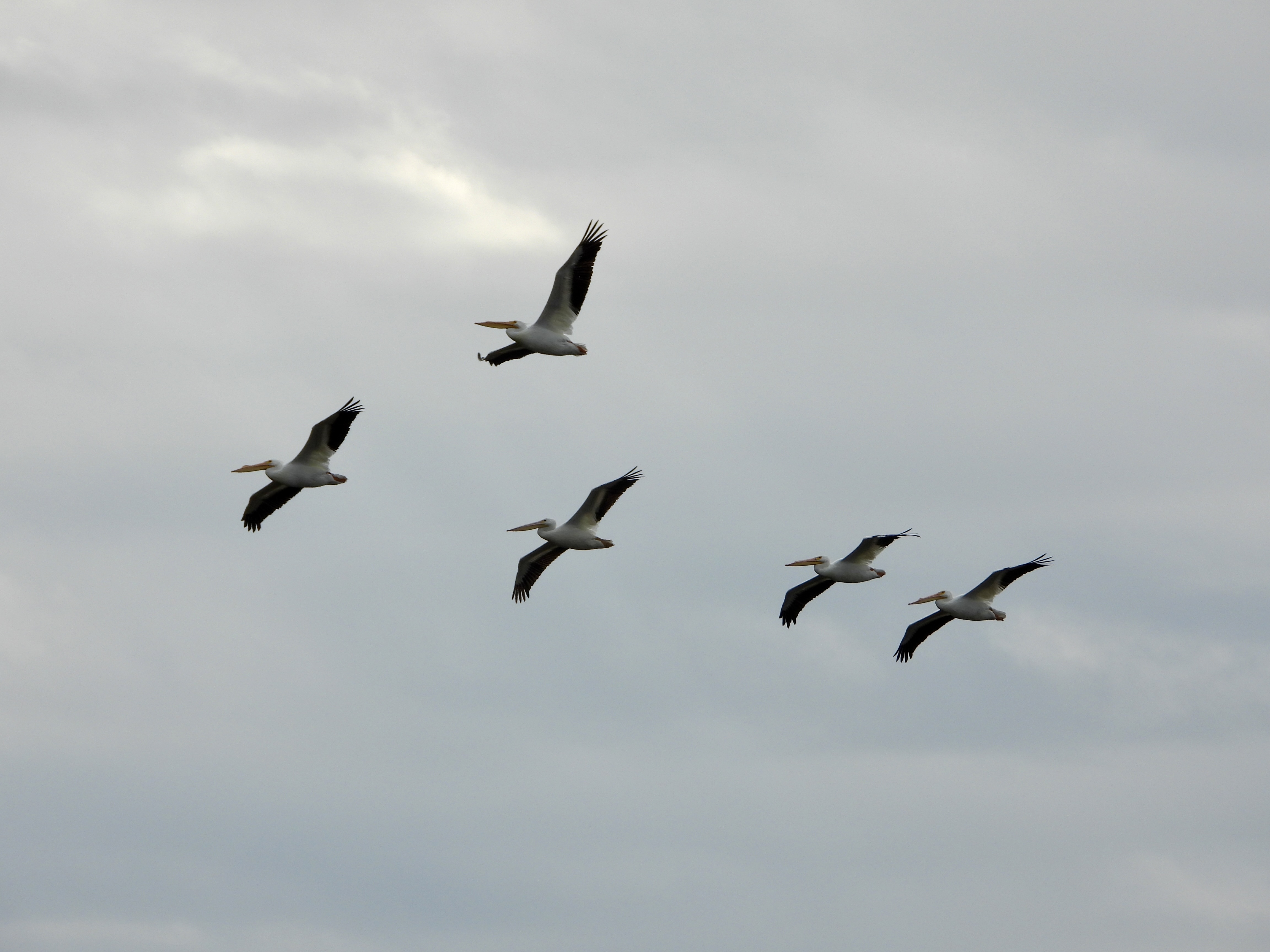
Great White Pelicans are one of the largest birds in North America with wingspans up to 9.5 feet across. These majestic birds migrate to Florida for winter feeding grounds.

This week I saw these two on the big pond, but they will be migrating north and west soon. The bump on the bills and bright yellow around the eyes show these two Great White Pelicans are adults and are beginning to show breeding plumage (March 18, 2023).


My husband is a photographer and immediately noticed I did not position myself with the light on my back as I took these photos. Sometimes that is not possible.


Though the white pelicans leave, the Brown Pelican stays year-round. 


See what you can see - January 2023


White Pelicans, January 28,2023

This week I revisited Jon Young's, What the Robin Knows, a book that deepens the kinship between humans and species. In it, he offers a simple suggestion to foster that kinship: go outside for twenty minutes to see what you can see. 

I did that. Here's what I saw after immediately stepping outside. A Yellow-rumped Warbler and then a Blue Jay.


Then I headed to the big pond. Ringed-necked Ducks, male and female


This photo of the Blue-gray Gnatcatcher shows the color of its name. Contrast this photo with this one taken at sunset. This photo deceives - this bird is super tiny.


A Common Snapping Turtle crossing Oak Drive. There are two types of snapping turtles in Florida. The Alligator Snapping Turtle has more ridges on its shell.


Two Northern Mockingbirds doing a spring dance - either territorial or mating.


And here's what neighbors saw recently. 


Kat tends a butterfly garden behind her unit, one with many Monarch caterpillars. She noticed a Monarch Butterfly just before it emerged.


Betsy saw a Monarch butterfly on the Mexican Marigold bloom in the butterfly garden.


Marc Holtsberg came upon a thriving hive of European Honey Bees. Beekeepers tell us this is a sign of a healthy ecosystem. 


Maybe those bees were the ones who found nectar from the Dombeya in front of our place.


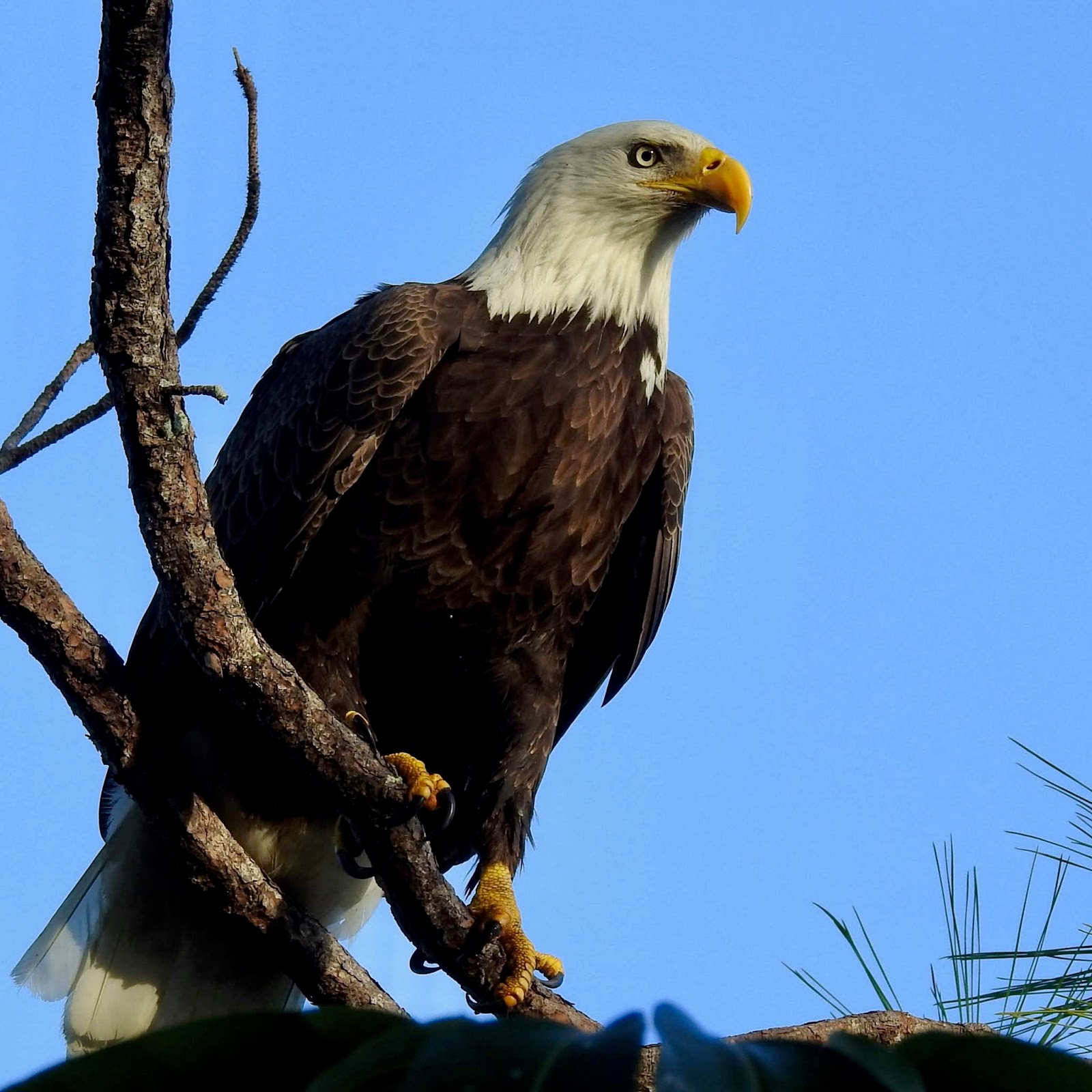
Marc also took this beautiful photo of a juvenile Bald Eagle (at Robinson Preserve).


He also was delighted by the Great Horned Owl fledgling. Its nest is adjacent to the entrance to the north entry of Robinson Preserve.


Nadia noticed the sunset. Look at that color.


February 2021, on my walk I saw...


A Tern? (certain) Royal Tern? (maybe) - Looking for a fish? (certain) 

When I look at birds while wearing my camera, most people I pass ask, "What did you see?" This is a response to that question.

The first photo is of a tern. But, which one. I thought Sandwich Tern. A couple birders (What's this Bird?) think this is a Royal Tern rather than a Caspian or Sandwich Tern. Rebekkah Leigh LaBlue who studied Least Terns in college wrote:
Personally, I would say no to Sandwich.

I’ll also say the angle and backlit nature of the photo DOES make it hard to concretely discern the color of some features, but the bill here—to me!—looks orangish. Even if it were an immature bird (which have more orangey beaks), this far into the first winter the beak would have gone black (with the characteristic yellow tip, like it was dipped in mustard—hence the Sandwich Tern name ðŸ™‚ ). Making less assumptions about the color, the bill looks too large, pointy, and thick at the base for a Sandwich Tern.
This tern is overall larger-looking to me. I also think the wing tips look too dark for a Sandwich Tern (but whether this is just backlighting is hard to say).
With that really pointy and chunky-based beak, darker wing tips, and what looks like a black cap, I’d suggest this is more likely a Royal or Caspian Tern. The cap on a Caspian extends below the eye; it does not on a Royal; I can’t tell here which is true.
All said, I think it’s hard to positively name a species here. But I DO think—personally!—you can rule out Sandwich. I can't confidently ID more specifically than that. (But my gut says Royal, for what it’s worth.) Would love someone else to throw in their two cents, also, since I've likely made a lot of assumptions, here!

I saw a male Northern Shoveler.

It's bill is BIG (about 2.5 inches) and shaped like a shovel. "The bill has about 110 fine projections (called lamellae) along the edges that act like a colander filtering out tiny crustaceans, seeds, and aquatic invertebrates from the water (All About Birds)." 

Two photographs, both Yellow-rumped Warblers. I still need help identifying warblers! They are so fast and we have many varieties during Florida's winter.


I saw a Great Blue Heron.


I saw an Anhinga.

Anhinga dries its wings looking out over the big pond. "Supple in water, clumsy on land, the anhinga is most serenely at home in the air. When not otherwise engaged, it spirals upward to breathtaking heights. There, with others of its kind, it rides the wind for hours on end for no apparent reason other than the simple joy of soaring."  - Book of North American Birds, p. 341.


I saw two White Pelicans flying over. 
Or, from another view, is that the sky looking back at me?


I saw a Red-bellied Woodpecker in its nest or where it sleeps.


Bird feast post #3 - American White Pelicans!


Neighbors Faith and John sent emails saying that the American White Pelicans were on the pond. I hurried over to see them. I watched three in one area hold their wings up while paddling in twirls around each other. And then, eyes closed. 


At first, I thought that one bird floated on top of another (not mating—this is not the time or place for that because White Pelicans mate in specific northern locations). Is it play? Researchers site no evidence that White Pelicans play. Do my eyes see two instead of one bird? Birding group thinks there are 2 birds here. I have a subscription with Cornell birds to read articles of research, and wrote to ask for an opinion.


I walked around to the eastern side of the pond. Whoosh, an Eagle landed in this nearby Slash Pine tree.


Then it bends down. Oh, that is the focus of attention. Its "baby" - well, not quite a baby, a juvenile.


Notice the power of the claw. Hey, is that a fish scale?


These Boat-Tailed Grackles on the ground (male on left; a female brownish in coloring on the right) and in the trees with the juvenile Eagle above seemed to just be hanging out. 


I continued to walk in the way birder and author Jon Young teaches: walk like a fox. It takes practice.
"Walk in the weight last style...light on your feet like foxes...so instead of swinging and stomping, raise one foot off the ground and let it hang their comfortably. Then slowly lower the foot to the ground, wherever it naturally falls. Don't lean forward. When the foot touches down, the other leg is still bearing all your weight. After the first foot is on the ground, shift your weight, still without leaning forward. Keep your head up."
That slow walking helps me open my gaze, sort of like an owl. (I wish.) Just sort of. I noticed the baby blue bill of a Lesser Scaup. The dark headed bird is male, the others are female Lesser Scaups.


A Great Egret, Little Blue Heron, and Snowy Egret.


I saw an American Coot. Notice the red eye and the white shield that is topped with what looks to me like an upside down, heart-shaped red mark. They were not a bit interested in the fish feast. They (and the Gallinules) eat aquatic plants.


The Common Gallinule looks like an American Coot, only they have a bright red shield on their forehead. (The Coot's is white.)


(Mostly) Cormorants on the pond edge.


 And look, flying lessons. Well, you know. This juvenile Anhinga drying its wings certainly made me think about how much I'd like to fly.


And, Great Egret.


Sometimes I think the Great Egret strikes a pose.


I notice the Hooded Merganser. Such a cutie pie. Only one, and I'm not sure if it's a female or male. I'll check in the spring when the eyes will have white circle markings indicating a female.


And, for a comparison‚ here is a Red-breasted Merganser I photographed taking a bath in the Gulf waves off Anna Maria Island.


I end with one of my favorite birds—the vulture. These are black vultures. They clean up our roads and here in Wildewood, helped clean the pond edge of dead fish. 


I enjoy watching them soar playfully in the wind.