Showing posts with label don't feed the birds. Show all posts

Blue-winged teal ducks


My partner called, "Look in the pond. I think there are two young ducks." I grabbed my camera to use its telephoto lens to see and take a few photos. I looked in my bird book and confirmed with birding friends Blue-winged teal ducks, an adult male and female.

The Cornell Lab of Orthinology website says that teals are often found dabbling with other dabblers. (So, what's a dabbler?) Like this Mallard taking a bath.


And not to miss out, this Muscovy duck waddled out of the pond and almost stood on my toe as if asking to see the photo! 


Why hello.


More likely, this duck is fed by neighbors. Please don't feed the birds, professionals ask of us. There is plenty of food for birds to forage. 

A reason I contain my urge to feed Florida birds is a little knowledge about the varying birds' digestive systems. Just like us, eating the wrong food hurts their bodies. 

(Here are other reasons not to feed ducks.) Okay, I'm in. No feeding.

The biggest reason I'll refrain: feeding endangers migrating birds from leaving when it's time. One time lost and birds don't migrate again according to David Sadkin, Ph.D, director of education at Wildlife, Inc. 

If you live in WWIIA, our regulations book includes a "no feeding wildlife rule,"  inspired by Florida Department of Wildlife guidance.

March 21, 2018

Want to help? Don't feed the birds. Eliminate rat poisons. Install owl boxes.

David Sakin, during a presentation to WW2A, holding a Barn Owl.

David Sadkin, Ph.D., education director at Wildelife, Inc. In his presentation to residents, he convinced us to not feed the birds. Though WW2A Association has a rule that prohibits feeding wildlife (as suggested by the Department of Fish and Wildlife), some residents want to draw birds closer to their windows. 

Oh boy, I understand that. 

When we lived in Columbus, OH, we put out feeders and suet boxes right next to a lookout over a ravine—the habitat and guidelines in Ohio differ from those here in Florida. 

At the talk, someone said that some neighbors feed the ducks regularly (usually cereals like Cheerios). Sadkin said this about feeding birds here in Wildewood Springs.
"Don't do it. 
You have many duck species here. Please don't feed ducks. 
Birds can't digest bread. The only birds that can metabolize bread are probably New York City pigeons. Birds don't have the enzymes to break down bread protein. (This includes Cheerios, crackers, or whatever you find as leftovers in your pantry.) What bread, cereals, and crackers do is pull the calcium out of their bones. And they get what is called soft-bone disease. It's incurable and it's a terrible way to die. Plus the birds become dependent on you for food.
If you want to attract animals, put in the type of plants that attract butterflies. Or plant what attracts birds naturally. Take care of your pond and it will feed the ducks. The less artificiality the better.  
One downside about feeders—if you're feeding migratory birds, you need to cut off their food at the time that they normally migrate. Or they won't leave. What triggers migration is the loss of their food source. If a bird misses a migratory cycle, it will never migrate again. Canadian Goose is now a problem because of feeding and missed migration. The population has grown. 
Keep this in mind: what falls from the feeder is food for mice, rats, and raccoons. We want wildlife to get their food from nature." 
Someone else asked Sadkin about raccoons as pests. He responded by inspiring us to address why raccoons have become a nuisance. He said that the ground under those bird feeders become leftovers for wildlife (raccoons, vermin) as well as unsecured garbage bins. 

Here's what Sadkin said about controlling mice and rats: 
Do you know the best way to reduce your mice and rat population? Install Owl boxes. (A couple Barn Owls gobble up up to 2000 vermin a year.) But if you do install boxes, do not let your pesticide company put out any poisons. When an owl or raptor, or any other animal eats a mouse or rat that ate the poison—you know what is in the poison, right? Warfarin. The animal's death is terrible.
I'm dreaming about the possibility of owl nesting boxes in Wildewood and that many more neighbors join our growing curiosity about ways to care for Wildewood's certified Audubon Wildlife habitat. 

Bird sightings by Beth, please don't feed the birds

Photo by Beth Price
This bird is in the flycatcher family. "With dark gray upperparts and a neat white tip to the tail, the Eastern Kingbird looks like it’s wearing a business suit. And this big-headed, broad-shouldered bird does mean business—just watch one harassing crows, Red-tailed Hawks, Great Blue Herons, and other birds that pass over its territory. Eastern Kingbirds often perch on wires in open areas and either sally out for flying insects or flutter slowly over the tops of grasses. They spend winters in South American forests, where they eat mainly fruit." All About Birds 

When I first moved to Wildewood Springs, I couldn't wait to put out bird feeders.

And then I learned that feeders were not allowed (in the Rules and Regulations). The plantings and setting provide food and shelter for wildlife. The HOA listens to wildlife professionals who encourage us to plant trees and plants that provide food for birds.

So, if you want to support wildlife in Wildewood Springs, please do not feed them.

“When people feed wildlife, the animals become dependent on and less wary of humans in general. The single person feeding the animal or bird isn't the only person affected by it, according to state game experts. One individual feeding wildlife is likely to cause problems for an entire neighborhood, because birds and animals don't understand fences or boundaries or rules, say wildlife officers.” Florida Fish and Wildlife Commission.

Bird feeders not only attract birds close to units, but they also attract squirrels, raccoons, mice, rats, and opossums that clean up the bird seeds and food that have fallen on the ground.


Yellow-crowned Night Heron. Nest in slash pine that leans into the pond off Oak Drive. 


Black-bellied Whistling Ducks


Magnolia Warbler


Rose-breasted Grosbeak


Red-bellied Woodpecker. A nest is in a Sabal Palm in Pineneedle Village


Canada Goose family with gosling


Bald Eagle over the pond

Palm Warbler in Slash Pine

Green Heron

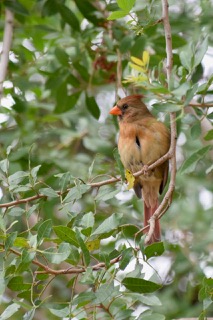
Female Cardinal

Cooper's Hawk

Limpkin. Looking for dinner.

Osprey. Pre-dive.

Little Blue Heron


All of these photographs were taken by Beth Price. They belong to her, so if you wish to reproduce them, ask her.