Showing posts with label pine warbler. Show all posts

In the lens: White Ibis, Blue-headed Vireo, Titmice, Yellow-Crowns

White Ibis

March 6, 2022

I took walks this weekend, so here is a showing of what I saw in the neighborhood. There are so many birds in the canopies, usually pairs. A sign that spring arrives soon.

Blue-headed Vireo (another photo from about this time last year)


Yellow-Crowned Night Herons, they're back! Courting and snuggling. Remember, that deep mustard color on the crown designates female.


Male Hairy Woodpecker


Pine Warbler


Northern Cardinal, male


Tufted Titmouse, actually a pair. Here's one of them.


They are fast!


A Male Red-Bellied Woodpecker enjoying the Bottlebrush Tree.


A Northern Mockingbird


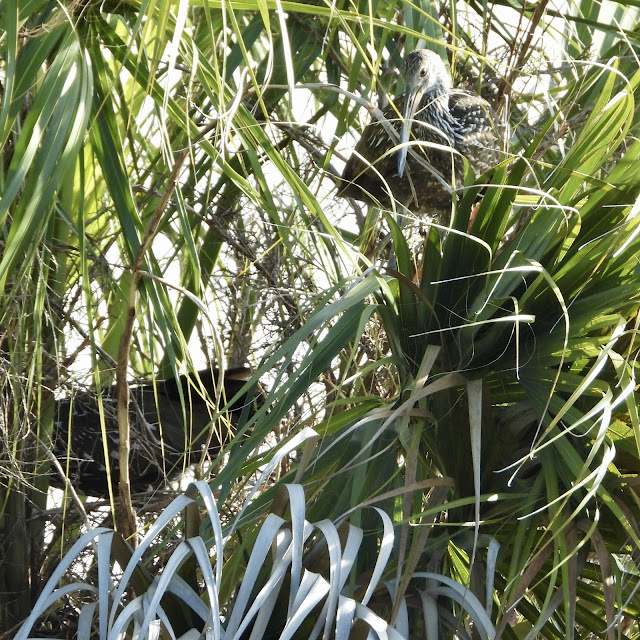
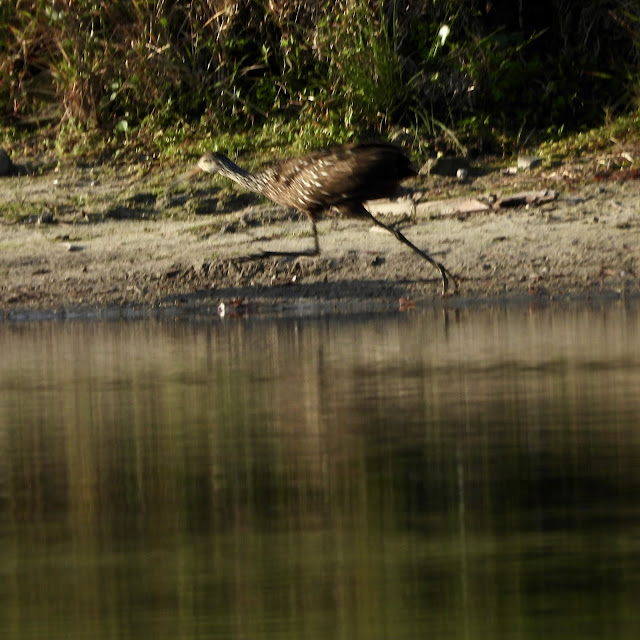
Limpkins chasing each other, then building their nest in an untrimmed Sabal Palm. 


American Fish Crow


No photo, but walking home from the pool two nights ago, we saw and heard two Barred Owls caterwauling. Now, if they'd just choose that nesting box in Pineneedle to make a family.

Cedar Waxwings and a warbler chorus while waiting for Limpkins

A flock of Cedar Waxwings feasting on berries. 2.21.22, 8:15 AM.

A flurry of posts. I know. But look, Cedar Waxwings

Dreaming of Cedar Waxwings in your section of Wildewood? They like small fruits such as berries, so plant Florida native trees and bushes like Serviceberry, Winterberry, Cedar, and Hawthorne. Let's plant!

For the first 10 minutes, I didn't see one bird. So I sat down. I knew if I waited 20 minutes or so, the birds would get used to my presence and appear. Just after the waxwings, the pair of Limpkins I saw yesterday flew in. Birds are habitual, so if you see them once, try again at the same time the next day. 

I again saw a courting gesture.


But one of them seemed to say "not so fast."


Limpkin flew in my direction. (I'm making progress on in-flight photography.) 


Limpkin flew to a tree that would be perfect nesting site, and provide a good chance to document nesting.


The location.


There was a welcoming committee. First a female Red-winged Blackbird. I know, I know. Where is the red and where is the black? Females look nothing like their male partners.

Warblers, too. A Yellow-rumped (Myrtle) Warbler.

A Palm Warbler. Note the yellowish vent under the tail coverts.

A Pine Warbler.

A bit of encouragement. Sit outside and look up. You'll see these tiny birds flitting about in the canopy and hear their delighted chirps. I promise - you'll relax and realize that we are so fortunate to live here.

Big pond duck meet up


Female Northern Shoveler Duck snuggled into a ball shape, and male Shoveler. 

About 8:30 this morning (2/4/22) I noticed a lot of ducks meeting in the middle of the pond - mallards, ring-necks, scaups, shovelers, widgeons, and mixed breeds.


Before I arrived at the pond's edge, I noticed a commotion of small birds in the Southern Oak trees. I heard then saw Grey Gnat Catchers. I got a photograph of one.


Polioptilids (a Gnatcatcher's formal name) glean small insects and other arthropods from leaves and branches, often flicking their tails actively as they forage. Despite their name, they very rarely take flying gnats on the wing.

A Tufted Titmouse singing like it was the best day ever. I agreed.


A female Downy Woodpecker. The tapping sounded like drumming. Both sexes drum on trees to claim territories, attract mates, and signal readiness for mating. The drumming is made up of very rapid, steady strikes almost fast enough to blend into a single sound.  All About Birds


A male Red-Bellied Woodpecker on an adjacent tree showing evidence for the red-belly name. "Hey, I hear you, Downy Woodpecker, nice drumming.


Then there were several Palm Warblers. Here's one.


And then, oh my duck galore.
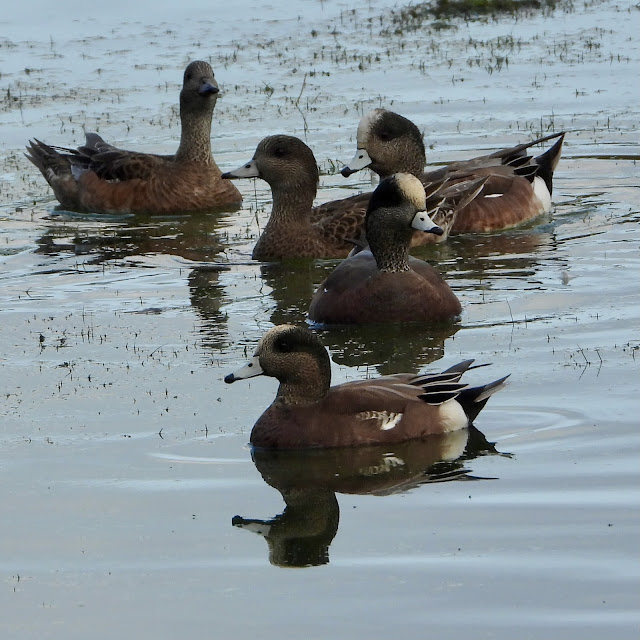
American Wigeon pairs were happily eating and making sounds like this. Wigeons are one of the more vocal ducks - their 3 part nasal whistle sounds a bit like someone softly blowing through a kazoo. Once you listen, you'll be able to identify this duck without seeing its markings.


A male American Widgeon has  a wide green postocular stripe seen when the light shines on it just right. Like this.

Two male Ring-Necked Ducks. So that ring neck identification? It's a cinnamon ring at the base of the neck, which gives the duck its name. It's a very poor field guide seen only at close range in good light. To date, I haven't seen it.


Northern Shoveler. Female and male. That beak is shovel-shaped all right.


Female


Male shoveler.


And last, a pair I've photographed over the last couple years. A mallard hybrid and a female so mixed in breed that a duck like this is referred to as "weird." (All About Birds says more about confused domestic ducks and hybrids here

Well, I got a look at how confused-hybrid happens. These two were swimming along.)


A male Muscovy Duck appeared. The pictures show what happened.


And just like that, a pair became a trio.

Warblers - a Southern Live Oak tree sounded like it was singing

Black-throated Green Warbler, 1.19.20

Today I found a Southern Live Oak on Wildewood Drive bustling with warblers. 

I saw for the first time a Black-throated Green Warbler. These birds are affectionately called "b-t greens" known for their call that can be transcribed as trees, trees, I love trees. I feel lucky to have gotten this photo since they stay high in the canopy. 

I saw other warblers in the same tree. I am grateful for the expertise of the birding group, What's This Bird? I need their help to identify most warblers.

For example, from the same tree, the next three photographs are of a Yellow-rumped Warbler.


Another type from the same tree, a Pine Warbler. 


A warbler I most easily identify—a Palm Warbler. The first photo from today, and a better photo from a few months ago.