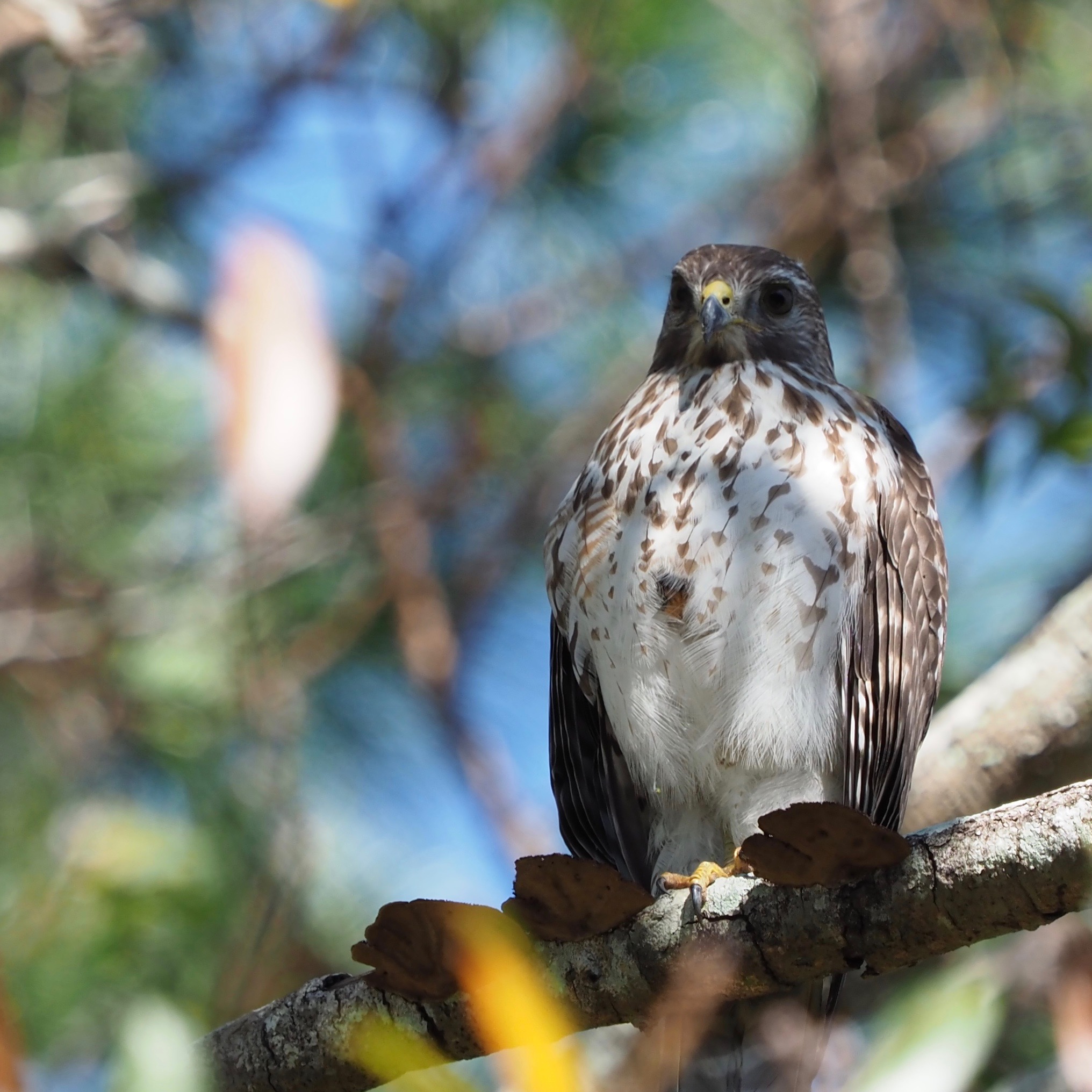
Showing posts with label red-shouldered hawk. Show all posts

Step outside for 5 minutes, let me know what you see


Wood Duck male and female, checking out the nesting box behind Steve Rumpf's place

I stepped out the back door to see what I could see. 

In a short five minute span of time, I saw wildlife. First, Eastern Gray Squirrel is known as nature's tree planter since it caches acorns and then forgets where they all are.


A Tri-Colored Heron. Are you thinking, "Hey, is that a Tri or Little Blue Heron?" Look here and learn how to distinguish the two herons. Clue - it's in the beak and breast colors.


Anhinga is around most days. While spring cleaning in the pollinator garden, it rained lightly for about a half hour. Before flying to the Southern Live Oak across from us in Woodlawn, Anhinga sat on the black pond ring that suspends the irrigation pipe that draws water for our neighborhood. 

Before dawn, I hear this sound (click listen here) and was able to identify anhinga who was also awake.

Across the pond, I saw a Great Blue Heron practicing choosing material for a nest. 

That's a pretty amazing twig, Great Blue Heron.

Heron dropped the twig, now fascinated with an array of choices.


A Red-Shoulder Hawk landed briefly. 


As my five minute break ended, I looked for the Florida Mottled Duck pair nesting in the wild area of the butterfly garden. I noticed a nest there every spring for the last few years. Often a Mallard-mix duck hangs with this pair. I look forward to ducklings. 


Last, as if in a call out that it's not always birds, birds, birds, an otter says hello.


PS.  I wish I had photos of the Barred Owls I hear most mornings. They are here in WS2A! I take that as good reporting on our incredible habitat. Joel Sartore's photograph from Instagram and informative encouragement: 


Early December 2021, sightings


Orchid Bee, in a Pineneedle butterfly garden.

This post is a collection of recent sightings in Wildewood. 

As I headed out for a walk this morning, Pat told me about the Barred Owl swooping over her to land on Nadia's courtyard wall. This week. A little later on the walk, Michael said he woke his wife to listen with him to two Barred Owls caterwauling in Springlakes. 

Daily I see warblers in the Laurel Oak canopy behind our place.

An early morning sunrise on a Red-Bellied Woodpecker. A male.


And a female.

In the same tree.


A Wood Stork and an American Fish Crow sharing a Norway Pine treetop. I knew it was a Fish Crow by its call.


A Red-Shouldered Hawk calling and calling. Tom was walking home from laps at the pool and heard it. I checked, and here hawk is:

Calling to who? I found them both here. Looks like it's find a mate season.

On Thanksgiving day, Marc Holtsberg sent this photo - an American Bald Eagle, taken in our neighborhood.

And, a few days ago, he photographed a juvenile American Bald Eagle in the Springlakes area off of Wildewood Drive. 


An Orchid Bee - a living jewel! 


On the big pond, a lot of Wood Storks following the rules. Looks like that Great Blue Heron has a mind of its own as it heads to the pond.


This is how some of our shell-back neighbors greet each other. Peninsula Cooters.


Birds are habitual. So, if you see a hummingbird at a particular place at a particular time of day, try again the next day. Chances are you'll get another sighting. This Osprey is on a Slash Pine branch many mornings I walk - I watch it leave to then grab a fish from the pond behind Tidewater.


Tricolored Heron, last of the molt. 


From Barb and Renee's lens: Goslings and a Red-Shouldered Hawk


Look! Canadian Goose Goslings

Barb Reis took this photograph of Canadian Goslings and their parents wandering through Pineneedle. We embrace all the birds, though seeing this family reminds us to uphold WWS's rule to not feed birds. Dr. Sadkin (Wildlife, Inc.) said when he visited WWS: "feeding is the biggest reason the Canadian Goose misses migration and then remain here."

The Goslings are darling, though.


Renee Fowler sent photos this week, too.

Renee wrote, "This Red-shouldered Hawk was sitting on the pool fence outside of my lanai. I took pictures from inside. [Bird] sat there for about 15 minutes. I see it flying through often. This is the pool at the intersection of Wildewood Boulevard and Oakview."

What is bird looking for? Probably a meal which means "Peromyscus mice, snakes, toads, and frogs...; carrion less often (Palmer 1988hDykstra et al. 2003Pranty 2002a), grasshoppers in quantities during outbreaks (Brown and Amadon 1968)." Birds of the World 

Beautiful bird, I see you: a humbling act of reciprocity

Pat said, "I saw our friend." 

She was referring to a resident Red-Shouldered Hawk often perched in what appears to be a favorite area at the bend of Pineneedle Drive. (I took this photograph earlier this week, January, 2021).

A sighting is a humbling act of reciprocity: we give care and protection to wildlife partly in return for the gifts they give us. There are many gifts bestowed by birds and wildlife to the cycle of life, but here it's delight. Then we extend that story by sharing our experiences with other people through story-telling (the earliest of social "media").

I thought about what it means to see a Red-Shouldered Chick or Blue-Grey Gnatcatcher or Great-Crested Flycatcher or Blue Jay or Blue-winged Teal Duck.  

Or any wildlife.  

And now Pat's telling is shared on this website. 

PS. From a subscription website called Birds of the World: more about the Red-Shoulder Hawk

Barb Reis' photo updates: Red-shouldered Hawk fledge, Wood Duck female, Yellow Crowned Night Heron


Barb Reis photographed a newly fledged Red-Shouldered Hawk enjoying baths in the pond. (June 5, 2020). 

According to Birds of the World (Cornell, a subscription website), fledges leave the nest at about 6 weeks, though they roost near or in the nest until about 14 weeks. Generally, the fledges are able to hunt for themselves (small mammals, reptiles, amphibians) at about 13 weeks, though a common call through summer are juveniles calling to be fed. By the way, the Red-shoulder Hawk can be described as natural vermin control.

Then, a few more photos of the female Wood Duck at the Barred Owl nesting box.


Last, look! In one of my favorite photographs, Barb took a family portrait of one of the Yellow Crowned Night Heron families. (May 7, 2020)


Spending time in nature is good medicine for us

Anhinga is on the pond edge bathing, dipping, and shaking. What delight to photograph when the light is like this!


I took Anhinga's portrait just after it caught and devoured this fish. Notice how different the light is in this portrait? 


During this stay-at-home and care-for-self-and-others time, wise people suggest spending time in nature, relaxing as much as possible, letting go, thinking of others, and going with the flow as ways to practice resilience. 

The birds show me how.

Early this morning (May 14, 2020) I watched a pair of Green Heron fledglings enjoy climbing around these branches. 


No trouble hanging on when the wind gusted.


I've watched an adult Green Heron continue to gather twigs, perhaps building up the sides of its nest similar to the Yellow Crowned Night Herons. I believe there are several nests close to each other.


Brown Thrasher reminds me to slow down when I eat, even think about what I'm eating as a way to appreciate food and that I have enough to eat when so many others do not. 


Crows are a favorite bird. Maybe I'm influenced by Bernd Heinrich's books, especially, The Mind of a Raven. Raven and crow, jays, rooks, magpies, jackdaws, chows, and treepies are oscine passerines, known as corvids. Talk about smart birds. 


Which reminds me, are you interested in which bird you are? Well, you know. Cornell Lab Group created this fun "test." HERE. 

Sometimes birds appear unfamiliar because of perspective. Like this Carolina Wren. I had to check this photograph with a birding group because I think of a wren with its tail up. 


The Yellow Crowned Night Heron chicks are lively in their nests. Some are branching, some have just hatched. Looking up, I notice a variety of movements and transfer this to my life: move, get exercise.


I checked the Pileated Woodpecker nest. Saw the adult climb in and then it was all tail feathers. Perhaps he was feeding chicks? 


Something wonderful about this time despite distancing: we find ways to connect with others. It is such a delight when birders share from their lens. Marc Holtsberg sent these photographs of recent sightings: Spoonbill Roseate, Red-shouldered Hawk, and Great Blue Heron.


Tom Higbee sent this trio of Wood Storks. I wonder how he got them to strike that pose on that tri-branched Norfolk Pine tree.


Steve reports a female Wood Duck nesting in Box #1 in Woodlawn. The male partner sits on a nearby branch most of the day waiting. I see patience. Like us facing and going with our days to greet whatever arises. 


Steve also reports a Carolina Wren pair nesting nearby. Oh, such wonders. That's the biggest suggestion I take from being with wildlife: begin with awe.