Showing posts with label Muscovy duck. Show all posts

Curious though wary is a healthy response


A family of raccoons donning their cuteness in this photo op yesterday,

 April 21, 2022

A family of four raccoons scurried along the pond yesterday. I grabbed my long-range lens camera to get a photo for you. When I headed outside to hide in the butterfly garden to observe them they noticed me, though I was across the pond. They quickly ducked into hiding.

This is a good sign. 

They were skittish of my presence, which is a healthy reaction to humans. My first thought after "gosh, they are darling" is a bravo to our neighborhood for not feeding birds and wildlife. Had they been fed, they likely would have approached me.

Another sighting from afar: an otter pair playing in a pond off Wildewood Drive and then a tumble about on the grass before jumping back in to fill up on fish.


One said in otter-speak to the other, "Come back in and fish with me."

I was grateful that this female Muscovy (established feral) and her chicks were not nearby at this time. 


Big pond duck meet up


Female Northern Shoveler Duck snuggled into a ball shape, and male Shoveler. 

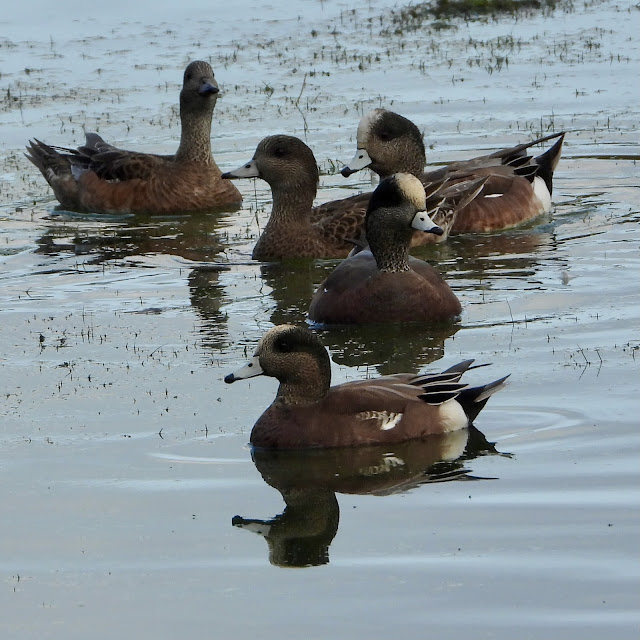
About 8:30 this morning (2/4/22) I noticed a lot of ducks meeting in the middle of the pond - mallards, ring-necks, scaups, shovelers, widgeons, and mixed breeds.


Before I arrived at the pond's edge, I noticed a commotion of small birds in the Southern Oak trees. I heard then saw Grey Gnat Catchers. I got a photograph of one.


Polioptilids (a Gnatcatcher's formal name) glean small insects and other arthropods from leaves and branches, often flicking their tails actively as they forage. Despite their name, they very rarely take flying gnats on the wing.

A Tufted Titmouse singing like it was the best day ever. I agreed.


A female Downy Woodpecker. The tapping sounded like drumming. Both sexes drum on trees to claim territories, attract mates, and signal readiness for mating. The drumming is made up of very rapid, steady strikes almost fast enough to blend into a single sound.  All About Birds


A male Red-Bellied Woodpecker on an adjacent tree showing evidence for the red-belly name. "Hey, I hear you, Downy Woodpecker, nice drumming.


Then there were several Palm Warblers. Here's one.


And then, oh my duck galore.
American Wigeon pairs were happily eating and making sounds like this. Wigeons are one of the more vocal ducks - their 3 part nasal whistle sounds a bit like someone softly blowing through a kazoo. Once you listen, you'll be able to identify this duck without seeing its markings.


A male American Widgeon has  a wide green postocular stripe seen when the light shines on it just right. Like this.

Two male Ring-Necked Ducks. So that ring neck identification? It's a cinnamon ring at the base of the neck, which gives the duck its name. It's a very poor field guide seen only at close range in good light. To date, I haven't seen it.


Northern Shoveler. Female and male. That beak is shovel-shaped all right.


Female


Male shoveler.


And last, a pair I've photographed over the last couple years. A mallard hybrid and a female so mixed in breed that a duck like this is referred to as "weird." (All About Birds says more about confused domestic ducks and hybrids here

Well, I got a look at how confused-hybrid happens. These two were swimming along.)


A male Muscovy Duck appeared. The pictures show what happened.


And just like that, a pair became a trio.

Devoted Muscovey Duck?


Muscovey Duck, female
My husband said, "What a strange photograph." 
Fitting, I thought. This is a strange scenario.

Early most mornings, I head to the butterfly garden. Adjacent to it is a feral female Muscovey Duck sitting in the crotch of a tree. So I also say hello to her. She's sitting on one egg. See?

(If you wonder how I got a photo, I moved the nearby bench next to the tree trunk, stood on it and held my camera high.)

One egg? Hmmm. Most clutches are 8 - 15 eggs. Is this what is called a good egg?!

The mama duck first cleared out the orchid plants we had placed there. (No problem. Pineneedle has placed almost 50 orchids in trees, so a couple for a hoped for duckling seems fair.)

Some days she's as curious about me as I am about her.

Incubation is 30-31 days. This is day 47, at least.

Such a devoted mama. Yet, I'm wondering about what devotion means within a false view. Just like those 20-some eggs dumped by multiple Wood Duck females in a nesting box, it appears this egg is not fertile.

Early September sauntering, 2021


A Glossy Ibis. Look at that color.

I delight in observing nesting birds. Nadia clued me on this one. Nestled in the middle of three orchid plants in a Carrotwood Tree sat a female Muscovy Duck. That was about 2 weeks ago.

She continues to sit. Sometimes she takes baths in the pond. 


A bluejay. One looking up. And quiet.


Not like a bunch calling which may mean a raptor or owl is nearby. Sure enough, a Barred Owl. I didn't have my camera. But you remember from these posts.

I'm aware that some don't like to think of snakes in Wildewood. But they are so important to the ecosystem. (For example, they help control the rodent population.) While weeding the butterfly garden I found a shed skin. I immediately gave it to my grandson who shared it at school.

The skin is probably from a non-venomous southern Black Racer snake, a garden friend I occasionally see - our neighborhood's fastest pest control. Besides vermin, Black Racers eat those invasive Cuban frogs according to specialists. Note the round eye, one indicator it's non-venomous.

Summer storms continue. I wonder how many of you, like me, love thunderstorms.


There is one particular bare branch behind Woodlawn. I check it when I walk. Almost always, there is a bird greeting the sunrise. This time it's a Mourning Dove. Did you know, like dogs, doves pant when it's hot? (Other interesting things about doves.)


While walking at dawn in Woodlawn, I took a photo of Pineneedle (the butterfly garden) from the the view of neighbors there.


Same view in 2015. The irrigation house was an eyesore. The HOA would be installing a new pump and filter. When the Board saw this photograph, they said yes to the Grounds Committee request to use plantings to hide the filter. It turned out well.


Pineneedle neighbors enjoy tending the garden and Woodlawn benefits. This reminds me to think of others.


There are 3 native to Florida small trees called Simpson Stoppers blooming right now in the pump/filter butterfly garden. The bees and butterflies love them.


A couple mornings ago, early, I circled behind Tidewater to check the pond. I saw this Wood Stork glide across the reflection of Springlakes. 


Later in the day, off to Anna Maria Island beach. A Royal Tern pair, one with lots to say, the other bowing to the news.

Birding fosters community

Wood Ducks, male and female and a Mottled x Mallard duck. March 6, 2021

Birding fosters a sense of community. It is delightful to hear from you about what you're noticing in Wildewood Springs. 

Steve from Woodlawn emailed. "Saw the Wood Ducks bobbing head courtship behaviors. Time to watch them." Yesterday I watched for over an hour and noticed that 2 hens are tending the nesting box! This photo is early morning; perhaps this is the nesting wood duck family.

Late morning, I can almost hear this hen say, "Your turn." Notice the change in light quality?

Maureen reported Red-shouldered Hawks mating at the corner of Wildewood and Oak Drives. If these red-shoulders have chicks, they'll look like this.

Maureen is a Lakeside neighbor who regularly picks up trash in and around our neighborhood. Maureen, do I say thank you enough? Thank you.

Faith saw an Osprey carrying large nesting material to their nest in the neighborhood and later, a pair perched together atop a tree on Wildewood Drive. She also saw one fly while carrying snake (a delicious meal if you're a raptor). So here is a photograph of a Wildewood residing Osprey taken by neighbor, Marc Holtsberg. Maybe its chick from last season is one Faith saw returning to its nest to have a family.

(Faith also saw 3 otters playing in the big pond. I photographed one in the Pineneedle pond this morning.)

Walter saw a Green Heron. I saw one of the pair flying back and forth nearby and then perch. I photographed it with Walter's camera. He loaned it to me when mine was recharging. Thanks, Walter.

Lois paints from her second story porch. While painting she said she had a visit from a small bird nibbling small insects from the window. Maybe it was a Blue-grey Gnat Catcher.


Or a warbler? Was it this one, Lois? A Palm Warbler? I took this photograph near the carport where your car is. Or look at this post for other warbler types. What luck to see these sweet, small birds up close.

Betsy mentioned that her sister who is visiting Wildewood thought that she saw an Oystercatcher since it had orange on its beak. This is possible, though I've not had a sighting in Wildewood. Head to the beach and you'll see them. 

Using that orange on the beak for a clue, I've seen the Black Skimmer skimming the big pond. Mostly I see them at the beach in large groups. Here is one of 3 skimming the water and some other photographs I took of their courting behavior.

Or, perhaps Betsy's sister saw a Common Moorhen or Common Gallinule. There are regular sightings of this bird here, especially on the edge of the big pond. 

Or maybe, it was a Muscovy Duck. Here's one I photographed near Timberlake. The fun part is that with our clues, we can check bird books and websites for help with identification.

Some exciting news! 

This week Jeanne and Tom Higbee and Toni had their first sighting of a Yellow Crowned Night Heron in the Slash Pine that held multiple nests for over five years. Though they are year-round residents in Florida, this is the time of year that they nest. Betty Pander wrote to say she saw the Herons on the bleached branches across from the Pineneedle and Woodlawn pond. Their sightings inspired me to go outside and look. There were 3 on the bleached branches.

Then they flew off in the direction of the Slash Pine they favor.


At 4 AM, I saw one of my favorite wildlife neighbors, an opossum, from our back window. I've been a fan ever since I had a chance to hold one when a wildlife group visited my classroom years ago. I wrote about how the opossum is a good friend to our habitat


Last, a common query: have you heard those two geese (Canada Goose) fly over like they're our early morning alarm clock? I have. These two.


Here is one settling in for a nap after waking us up.