Showing posts with label Mallard. Show all posts

Stepping outside to look up


Good, beautiful morning, about 7:00 am, 4/9/23 (Easter)

I begin the day by stepping outside to look up. I see this sky. 

Often I walk and then sit down for at least 20 minutes. When I still and sit, I notice what's around me.

I heard someone say again, "There are no birds now." Maybe this was a comment about migration. The many different warblers that filled the oak behind our place have left. But, oh my goodness, there are birds. 

10 Wood Duck ducklings a few days ago. I saw them leave a natural area and hop into the pond. Maybe this was their first day. 

Saturday afternoon, 4/8/23 - there are 6 ducklings. A Little Blue Heron is in the foreground.


Female Downy Woodpecker, April 2023. Difference between Downy and Hairy Woodpeckers? HERE.


There are many ducks. Here is a Lesser Scaup, male.


Blue-winged Teal Duck, male and female (dabbling)

This (I think) Mallard female duck is going to get in trouble.

An Eagle flew overhead.


Susan Herman shared a photo of a soon-to-be Monarch chrysalis.


From the butterfly garden, I took a photo of a soon-to-be-born Monarch butterfly.


Behind Pat and Cathy's place, a Belted Kingfisher in the Southern Live Oak.


Cardinals are plentiful! A male portrait.


 A female looking for Betty, or its male partner.


Yeah. She's looking for him. A male Cardinal looking back at that female.


Tri-Colored Heron, breeding plumage. This photo shows its neck. That is a good identifying clue.


The TCH used its wings to hop along the shallow water to catch fish.


It caught one!


A Brown Thrasher. Not as good a photo as Barb would get, though you get the idea.


Three male Wood Ducks, big pond.


Behind our place, a pair of Great Blue Herons. One in the water spray mist.


The other a distance away. They kept an eye on each other.


Keeping an eye on us. This curious juvenile Raccoon came down far enough to peek out over the yellow orchid blooms into our back window. Happy spring morning little masked-guy.


Brown Anole often checks us out, too. After all, we share a neighborhood and world.


Enjoy this beautiful day! Take a chair outside and sit in the shade. After 15 minutes, the birds will get used to your presence, and if you're like me, you'll wonder why you don't spend more time in nature. This wonderful photo was taken by Terry.

Our actions affect others


Great Egret and its lunch - a rat! 7.3.22

Behind one of Pineneedle's butterfly gardens in the pond is a black ring*. In July last year, a Mallard hen took her chicks to practice climbing up and down the ring's edge.


A Wood Duck family did the same thing two years ago in July.


Other birds perch on the ring. An Anhingha swallows a caught fish. Cormorants dry their wings. Daily I look to see what's happening.

So I need to tell you that recently I noticed two deceased birds inside the ring: What's this Bird? said they were two Muscovy Ducks. I don't know what happened, but I thought they were poisoned since they were not visibly injured nor eaten by other wildlife. I did not retrieve and take them to Wildlife, Inc. for tests when I first saw them. They decomposed in the center of the ring. 


So, though I'm uncertain about the cause of death, this is another opportunity to share information about poisons and encourage using extra care around the use of pesticides, herbicides, and rat poisons.

Wildewood Springs HOAs disallow rat poisons because of their disruption to wildlife habitat and cycles, the cruel deaths to wildlife, and in the words of a vermin control specialist, "Poisons don't work." Vermin are best controlled by their predators. 

Besides Great Egrets, Great Blue Herons eat rats. It's a favorite food. If a rat has eaten rat poison, it dies slowly. If eaten by another animal, that animal dies, too. Fewer Great Blues and Great Egrets and Raptors = more rats.

Eagles like rats, too. 

Gail and Ed Straight of Wildlife, Inc. told us about the sick American Eagle they tried to save when it was found on the IMG golf course. 

Something the Wildewood Springs community does best - we share information that helps us maintain this rare and precious wetland habitat. Perhaps there are some wildlife we don't like, but we can enlarge our perspective to see that there is room for all of us. Even a need.

PS Great Egrets also eat fish, and strike elegant poses.


 * The black ring's purpose is to hold a pipe that draws water to irrigate Pineneedle's landscape. 

Eggs! Tom has an egg update

May 3, 2022

A few days ago, Thomas Couillard sent this photo showing 3 new Yellow-Crowned Night Heron chicks have hatched in one of the nests in our neighborhood (halves of the 3 eggs shown). 

He reminds us to mark our calendars for 6 weeks from now when the chicks grow into fledges and start playing - and frighten us with hopping all over the nest. What?! Look here


Sometimes falls happen from activity or the way nature works things out. (From a couple years ago - this chick was rushed to Wildlife, Inc., a wildlife rehab and release organization.)


Tom also shared this surprise. At 6:30 AM while he was swimming at the lap pool, a duck laid an egg on its edge. This is not an embellished story - look!


Yellow-crowned Night Herons lay their eggs in nests they build high in Slash Pine trees. The (p)layer in this case looks like a Mallard hen. 


Big pond duck meet up


Female Northern Shoveler Duck snuggled into a ball shape, and male Shoveler. 

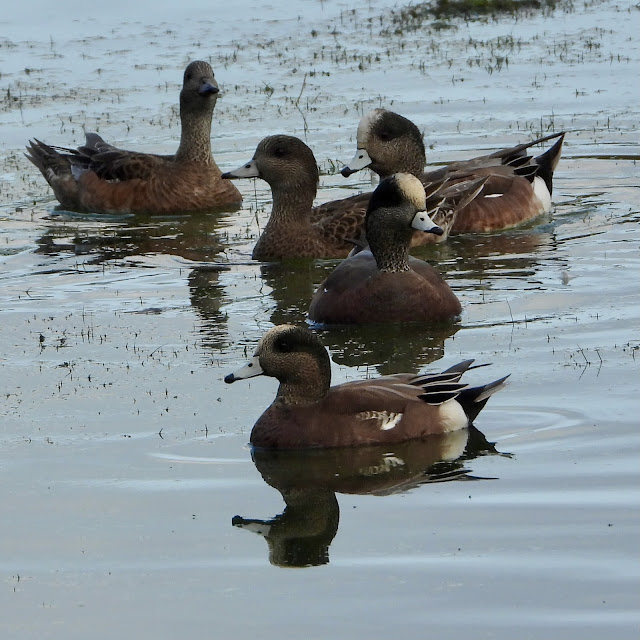
About 8:30 this morning (2/4/22) I noticed a lot of ducks meeting in the middle of the pond - mallards, ring-necks, scaups, shovelers, widgeons, and mixed breeds.


Before I arrived at the pond's edge, I noticed a commotion of small birds in the Southern Oak trees. I heard then saw Grey Gnat Catchers. I got a photograph of one.


Polioptilids (a Gnatcatcher's formal name) glean small insects and other arthropods from leaves and branches, often flicking their tails actively as they forage. Despite their name, they very rarely take flying gnats on the wing.

A Tufted Titmouse singing like it was the best day ever. I agreed.


A female Downy Woodpecker. The tapping sounded like drumming. Both sexes drum on trees to claim territories, attract mates, and signal readiness for mating. The drumming is made up of very rapid, steady strikes almost fast enough to blend into a single sound.  All About Birds


A male Red-Bellied Woodpecker on an adjacent tree showing evidence for the red-belly name. "Hey, I hear you, Downy Woodpecker, nice drumming.


Then there were several Palm Warblers. Here's one.


And then, oh my duck galore.
American Wigeon pairs were happily eating and making sounds like this. Wigeons are one of the more vocal ducks - their 3 part nasal whistle sounds a bit like someone softly blowing through a kazoo. Once you listen, you'll be able to identify this duck without seeing its markings.


A male American Widgeon has  a wide green postocular stripe seen when the light shines on it just right. Like this.

Two male Ring-Necked Ducks. So that ring neck identification? It's a cinnamon ring at the base of the neck, which gives the duck its name. It's a very poor field guide seen only at close range in good light. To date, I haven't seen it.


Northern Shoveler. Female and male. That beak is shovel-shaped all right.


Female


Male shoveler.


And last, a pair I've photographed over the last couple years. A mallard hybrid and a female so mixed in breed that a duck like this is referred to as "weird." (All About Birds says more about confused domestic ducks and hybrids here

Well, I got a look at how confused-hybrid happens. These two were swimming along.)


A male Muscovy Duck appeared. The pictures show what happened.


And just like that, a pair became a trio.