Showing posts with label Mallard duck. Show all posts

Mid-march, a family of Mallard chicks


A female Mallard Duck and 7 of her 10 chicks

Jeanne sent a message saying that Swallow-tailed Kites were soaring above the Woodlawn pool and because of Marc's photographs taken in WWS a few weeks ago, she could identify and delight in them with others at the pool. Her message affirms one of my hopes: that we learn, enjoy, and care for this precious Audubon-certified neighborhood

The birds are vociferous, and busy. Many of us pause in our walks to enjoy them. 

The Limpkins continue to nest in this Sabal Palm.


Limpkin sits.


A Tri-Colored Heron was nearby.

On Wildewood Drive, two Mourning Doves courted by preening each other, mated, and more preening.


Pie-billed Grebe on the big pond. Look for a solitary bird that stays offshore.


A Great Crested Flycatcher, a bird I hear and mostly cannot locate in the tree canopy. This time, I have a photo for you!


Palm Warbler (yellow underparts helps distinguish it in this pose from the Pine Warbler) - Pinehurst neighbor Allen and I gazed upward to the point of feeling Warbler neck. So many warblers hopping about. Too fast to photo ID.


 Carolina Wren sang and sang and sang. I sat down to marvel about its unrelenting call.


Those Mallard chicks' first days exploring the pond habitat.


I count 4 pairs of Yellow-Crowned Night Herons at various stages of courtship and nest building.  


Earth Day, many of us looking out and up

Great Egret, 4.22.20. Earth Day. (SM Barrett)

"It is in you that you must look, not around you." – Eugene Delacroix. 

This quote is good guidance for Earth Day. I'm encouraged to explore my habits and see if they align with what I care about. I found it in award-winning scientist and brilliant teacher Hope Jahren's book, The Story of More. The book's message is to "use less, share more."

Such noticing. Marc Holtsberg took his camera on an early walk. Look what he saw. A pair of Osprey, likely from a neighborhood nest. (Marc's photograph)
Playful rascals - American River Otters. (Marc's photograph.)
Marc said that this family of 12 (!) departed the nest recently. (Marc's photograph.)
And, one of my favorite birds! A Limpkin. (If you haven't heard its call, you can find it in this link to All About Birds.) You'll never forget it. Thank you, Marc, for this photograph, especially.
From Wild Palm neighbor, Sandy, an invite to a Barred Owl cam. This is the type of family we hope finds our recently installed nesting box!
Pineneedle neighbor Walter Goodrich photographed from his window this American Bald Eagle cleaning up the leftovers of a too-much-fish-for-an Anhinga:

Here are some recent sights that caught my attention.

Has anyone else noticed how active the ducks are right now? This Mallard hen kept 3 males fast-waddling behind her, jumping, flying in circles, heading off into the Wedelia (laying eggs or what comes before?) She was vociferous!
A Red-Eared Slider Turtle took notice of the commotion.


This female Pileated Woodpecker checked out a Laurel Oak and maybe this Dendrobium Orchid. They are pretty delicious. (The orchid!) Have you tried one? Pineneedle's Grounds Committee has placed 35 orchids onto mostly oak trees for viewing, not eating.
(Yes, you can eat orchids and other flowers. Like Nasturtiums. Here is a photo of our dinner salad, nasturtium flower and leaves from our neighborhood Butterfly Garden.)
Here she is a few minutes later pausing in the Southern Live Oak behind Rosalie, Pat, and Betsy and Jim's. Let her inspire us to reflect on how fortunate we are to live in an Audubon Certified Wildlife area.
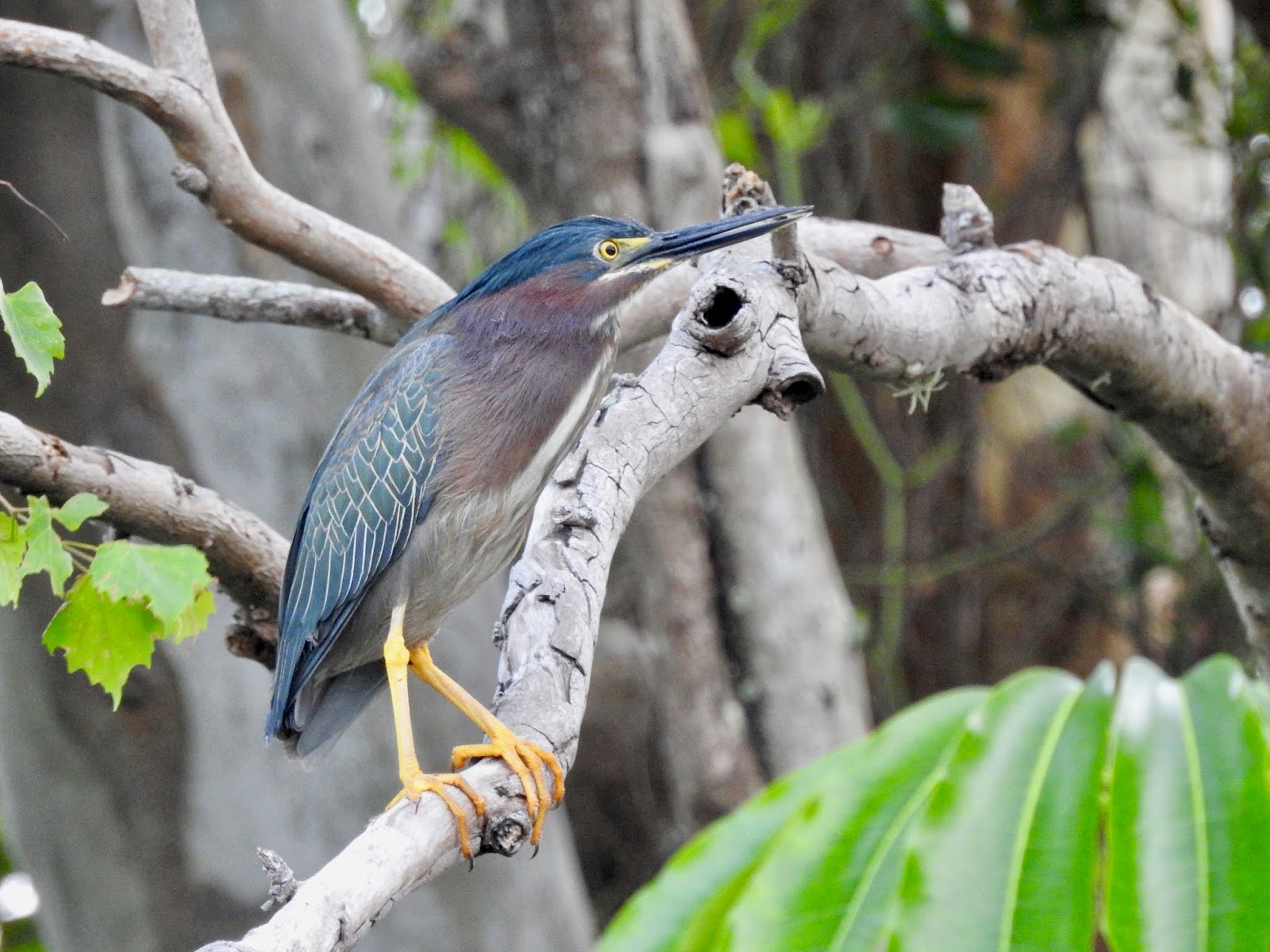
A Green Heron pair continues to nest. This is one of the two. Look for their activity at dusk.
Moonflower vine is one of the lovelies along Wildewood's border on 34th. I took this photo of a partly-prepared-for-weather blossom under the dim light of a soon-to-burst bluster of rain. Like sails unfurled it reminds me of a memorable wordless sail with a girlfriend in a boat her husband built.
Rounding the curve to our home, this airplane contrail (is that what you think this is?) seemed to be pointing out Wildewood, a wonderful place in the world.
UPDATE: Marc Holtsberg says that the contrail is from the rocket launch from Cape Canaveral yesterday afternoon. See the launch replay HERE.
Note - All photographs by others on Wildewood Wonders belong to the photographer named. Posted here with permission.

Mallard, Mottled, American Black Ducks?


It is challenging to identify duck types. 

When I found duck eggs in the butterfly garden near the pond (cracked open as if hatched), I wondered whether it was a Mallard or Mottled duck nest. I needed ID help from the Facebook group, What's this bird? They thought that all were to some degree Mallard and that 3 in this photo were part Mottled Duck. Another felt that the duck furthest in the background was an American Black Duck. 

I linked each to All About Birds (Cornell Bird Lab) so you can look for yourself and take a guess about their ID.
Many species of waterfowl form hybrids, and Mallards are particularly known for this, hybridizing with American Black Duck, Mottled Duck, Gadwall, Northern Pintail, Cinnamon Teal, Green-winged Teal, and Canvasback, as well as Hawaiian Ducks, the Grey Duck of New Zealand, and the Pacific Black Duck of Australia. - All About Birds
The family hangs out in the garden and pond nearby. 

Here is a part of a hatched egg and a view of the setting. See the duck egg under the Muhly Grass?


Here they are nibbling away at the pond edge.


Mottled Ducks consume a variety of plant and animal matter, which varies greatly by region and season. Common plants taken include the seeds and shoots of many grasses, wild millet, smartweed, spikerush, paspalum, sea purslane, wigeon grass, and bulrush...Mottled Ducks meticulously strip grass and rice seeds by rapidly opening and closing the bill along the length of the seedhead. Invertebrate prey include snails, crayfish, beetles, amphipods (zooplankton), dragonflies, and midges. Small fish are also eaten. Breeding females consume mostly invertebrates, as do ducklings. - All About Birds, Mottled Duck


This (mostly) Mottled Duck was quacking. I read that quacks come from females and the raspy-type duck sounds are the males (All About Birds). 
The quintessential duck’s quack is the sound of the female mallard. Females often give this call in a series of 2–10 quacks that begin loudly and get softer. When courting, she may give a paired form of this quack. The male does not quack; instead he gives a quieter, rasping, one- or two-noted call. Ducklings make soft, shrill whistles when alarmed.

Here are two of them hanging out with a Great Egret who moments later caught a fish. 


After I took this photograph (they were across the pond), as quick as they appear to fall asleep, they woke.


An early morning Glossy Ibis gathering (and BB Whistling Duck Family update)

Glossy Ibis

I continue to visit the pond to check on the Black-Bellied Whistling Duck Family. Today, new friend Faith from Springlakes and I checked the pond at noon, later than I usually walk. We didn't see them. However, yesterday is a different story.


I found a group of birds hanging out!


I noticed Glossy Ibis, mostly juveniles. Oh, and one Common Gallinule (notice the bird with red on its bill in the above photograph).


Mallard  


Mottled Duck.


When the Whistling family paddled up, they "asked" that the other ducks leave. 


They did. All clear for the chicks to come ashore. 


And then mama stood with this cuddle of chicks who fell fast asleep.


Then this. They woke and stood in a strike-a-pose moment, looking in one direction. Snap. What a great photo. 


Energized, they ran in my direction. Even with my long range lens, it felt like the family was heading over to say hello.


But no. They were heading to jump in the pond.


Blue-winged teal ducks


My partner called, "Look in the pond. I think there are two young ducks." I grabbed my camera to use its telephoto lens to see and take a few photos. I looked in my bird book and confirmed with birding friends Blue-winged teal ducks, an adult male and female.

The Cornell Lab of Orthinology website says that teals are often found dabbling with other dabblers. (So, what's a dabbler?) Like this Mallard taking a bath.


And not to miss out, this Muscovy duck waddled out of the pond and almost stood on my toe as if asking to see the photo! 


Why hello.


More likely, this duck is fed by neighbors. Please don't feed the birds, professionals ask of us. There is plenty of food for birds to forage. 

A reason I contain my urge to feed Florida birds is a little knowledge about the varying birds' digestive systems. Just like us, eating the wrong food hurts their bodies. 

(Here are other reasons not to feed ducks.) Okay, I'm in. No feeding.

The biggest reason I'll refrain: feeding endangers migrating birds from leaving when it's time. One time lost and birds don't migrate again according to David Sadkin, Ph.D, director of education at Wildlife, Inc. 

If you live in WWIIA, our regulations book includes a "no feeding wildlife rule,"  inspired by Florida Department of Wildlife guidance.

March 21, 2018