Showing posts with label Red-bellied woodpecker. Show all posts

Softly alert and open


Can you find the Tufted Titmouse

Birding takes a sauntering gait and widened peripheral vision. Funny, when I place gentle attention on my breath, I relax a bit. Enough to step into being with nature and open to what arises. When I hear a bird call, I stop and pause. I look out and up in the direction of the sound and wait for a flutter of movement. 

I heard this call

Then I sensed a flutter in a Sabal Palm. That photo shows the challenge of locating a tiny bird in the expanse of green we are so privileged to share with all wildlife. What an incredible place Wildewood is!

Titmouse flew to a Southern Live Oak. I saw one bird but heard reciprocation.

And then two! A pair flitting here and there, calling to each other. Getting these photos was lucky. (Today is March 17, 2023 - happy St. Patrick's Day!)

Here are other sightings of the Tufted Titmouse in our neighborhood.

All About Birds says that titmice often flock with chickadees, nuthatches, and woodpeckers. Nearby, this Red-bellied Woodpecker.

Big pond duck meet up


Female Northern Shoveler Duck snuggled into a ball shape, and male Shoveler. 

About 8:30 this morning (2/4/22) I noticed a lot of ducks meeting in the middle of the pond - mallards, ring-necks, scaups, shovelers, widgeons, and mixed breeds.


Before I arrived at the pond's edge, I noticed a commotion of small birds in the Southern Oak trees. I heard then saw Grey Gnat Catchers. I got a photograph of one.


Polioptilids (a Gnatcatcher's formal name) glean small insects and other arthropods from leaves and branches, often flicking their tails actively as they forage. Despite their name, they very rarely take flying gnats on the wing.

A Tufted Titmouse singing like it was the best day ever. I agreed.


A female Downy Woodpecker. The tapping sounded like drumming. Both sexes drum on trees to claim territories, attract mates, and signal readiness for mating. The drumming is made up of very rapid, steady strikes almost fast enough to blend into a single sound.  All About Birds


A male Red-Bellied Woodpecker on an adjacent tree showing evidence for the red-belly name. "Hey, I hear you, Downy Woodpecker, nice drumming.


Then there were several Palm Warblers. Here's one.


And then, oh my duck galore.
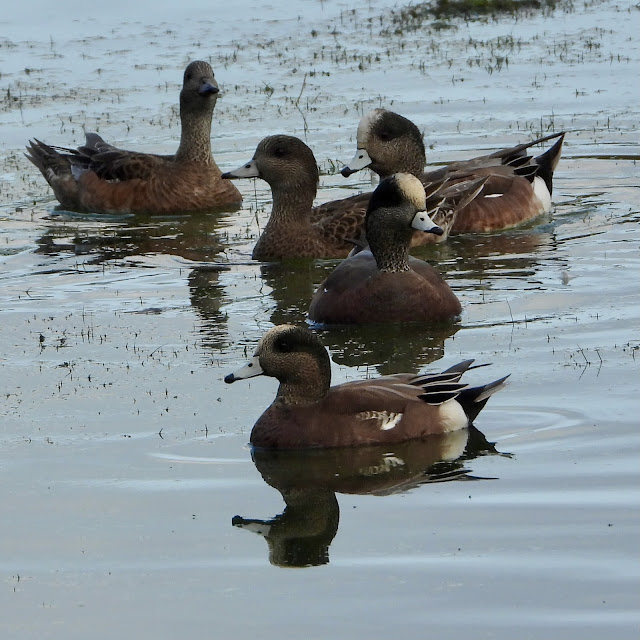
American Wigeon pairs were happily eating and making sounds like this. Wigeons are one of the more vocal ducks - their 3 part nasal whistle sounds a bit like someone softly blowing through a kazoo. Once you listen, you'll be able to identify this duck without seeing its markings.


A male American Widgeon has  a wide green postocular stripe seen when the light shines on it just right. Like this.

Two male Ring-Necked Ducks. So that ring neck identification? It's a cinnamon ring at the base of the neck, which gives the duck its name. It's a very poor field guide seen only at close range in good light. To date, I haven't seen it.


Northern Shoveler. Female and male. That beak is shovel-shaped all right.


Female


Male shoveler.


And last, a pair I've photographed over the last couple years. A mallard hybrid and a female so mixed in breed that a duck like this is referred to as "weird." (All About Birds says more about confused domestic ducks and hybrids here

Well, I got a look at how confused-hybrid happens. These two were swimming along.)


A male Muscovy Duck appeared. The pictures show what happened.


And just like that, a pair became a trio.

A chilly day , nestled birds - and Marc's photos

Great Egret, breeding plumage, Saturday, January 29, 2022. 

Just before sunset, I stepped outside. I noticed a Great Egret in breeding plumage nestled in the foliage next to the pond. It's chilly. Tonight will be one of the cooler nights according to Dark Sky. 

I walked toward the pollinator garden and saw these two, a Wood Stork and another Great Egret also in breeding plumage. I wondered if it was the other's parter.


Marc Holtsberg had a fascinating birding day, too. He photographed, Great Horned Owlets in a nearby nest (not in Wildewood Springs). 


This is a pair of Red-Bellied Woodpeckers in Wildewood. Marc said the nest was destroyed in the winds.


I checked the Blue Heron nest today, late afternoon. The herons are probably very low in the nest.

Before I came inside from the backyard, Wood Stork gazed my way. Hello beautiful bird.


Wood Storks like most of the species of storks lack a syrinx, a vocal organ, and so, are mute. They clatter their bills against each other as a mode of communication in their colonies and nests. The clacks sound like this. Chicks though are loud in the nest. Their sound is nasally and sounds like a braying donkey.

Early December 2021, sightings


Orchid Bee, in a Pineneedle butterfly garden.

This post is a collection of recent sightings in Wildewood. 

As I headed out for a walk this morning, Pat told me about the Barred Owl swooping over her to land on Nadia's courtyard wall. This week. A little later on the walk, Michael said he woke his wife to listen with him to two Barred Owls caterwauling in Springlakes. 

Daily I see warblers in the Laurel Oak canopy behind our place.

An early morning sunrise on a Red-Bellied Woodpecker. A male.


And a female.

In the same tree.


A Wood Stork and an American Fish Crow sharing a Norway Pine treetop. I knew it was a Fish Crow by its call.


A Red-Shouldered Hawk calling and calling. Tom was walking home from laps at the pool and heard it. I checked, and here hawk is:

Calling to who? I found them both here. Looks like it's find a mate season.

On Thanksgiving day, Marc Holtsberg sent this photo - an American Bald Eagle, taken in our neighborhood.

And, a few days ago, he photographed a juvenile American Bald Eagle in the Springlakes area off of Wildewood Drive. 


An Orchid Bee - a living jewel! 


On the big pond, a lot of Wood Storks following the rules. Looks like that Great Blue Heron has a mind of its own as it heads to the pond.


This is how some of our shell-back neighbors greet each other. Peninsula Cooters.


Birds are habitual. So, if you see a hummingbird at a particular place at a particular time of day, try again the next day. Chances are you'll get another sighting. This Osprey is on a Slash Pine branch many mornings I walk - I watch it leave to then grab a fish from the pond behind Tidewater.


Tricolored Heron, last of the molt. 


Room for all of us

Opening with very young wings.

I haven't yet said that the Barred Owl pair shares territory with the Yellow-Crowned Night Herons. As I approach the nest early mornings, I hold my breath hoping there continues to be room for all of us. Seeing this chick do what it inherently knows to do encourages me to carry on with whatever this day brings.

A few things are different this YCNH breeding season:

The YCNH chicks are often alone.

This differs from past years where one adult would stay at the nest and one would forage and return to feed the chicks.

The adult YCNHs are not building the nest edges higher.

YCNH pair would at this point in the raising-young-process be gathering live twigs to weave the nest higher (like making a play pen) as the rambunctious and not quite skilled chicks flap-hop in the nest. I have not seen much of this behavior.

Perhaps the new owl neighbors affect the herons.

So, look at this pose:


I see in heron's outstretched wings a heart. My thought - in times of difficulty (for example, herons having a Barred Owl neighbor) the only sane response is love. This YCNH chick notices.


That's one chick, but I know there are at least 3 in this nest. How can I be sure? I count beaks.


I leave with a thought that all is well for both herons and Barred Owl(s).

What owl you ask?

This one. Neighbor Marc Holtsberg took these gorgeous photos of one of the two resident Barred Owls.


I continued walking through the open area near the pond of Woodlawn. The light made the birds look perky. I saw:

A Northern Cardinal (molting).


A Green Heron


A male Red-bellied Woodpecker


A Pileated Woodpecker (one of the 4 reported here recently) briefly still and then noisily flitting about on an insect hunt.


One more time I swung by the Slash Pine to check the YCNH chicks. I saw but was not quick enough to get you a photo of a pair of Downy Woodpeckers - the smaller-billed woodpecker.

But, wow, I did get this photo of visitors in the same Slash Pine as the herons: Black-Bellied Whistling Ducks! See why the black-belly name?


Besides bird sightings, I love when I see neighbors along the way. I met Lawrence, WWS1 security person. He told me about seeing a fox in the Springdale and Sherwood backyard areas. This was the best news! I would love to photograph a resident fox.

I also said hello to Cali (Calliope) and her sweet dog Diamond and met Paula who lives in Pinehurst and her visitor, Steff from the Central Park area of New York City. Paula, Steff and I were mesmerized by a napping Spoonbill Roseate - a special spoonbill, the one with a leg injury. I've photographed this spoonbill for three seasons. Precious bird and neighbor connections.


June 1, 2021